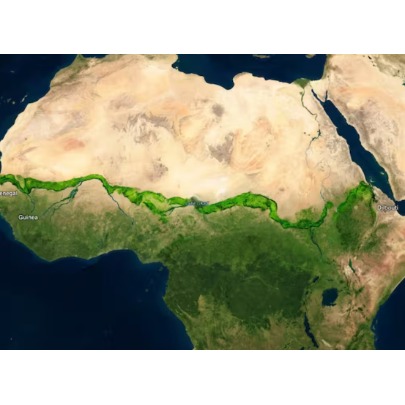
A green wall: the plan that 11 African countries have to stop the advance of the Sahara desert
The project seeks to restore 100 million hectares to combat desertification; However, after almost two decades of implementation, progress is limited by corruption and lack of funds.
Faced with the unstoppable degradation of the soil and the relentless advance of arid areas, 11 African countries launched the so-called Great Green Wall. This is a project of monumental scale that aims to extend for 8,000 kilometers, from Djibouti to Senegal, with the central objective of creating a natural barrier of trees to stop the expansion of the Sahara towards the south of the continent. The initiative, launched in 2007, seeks to restore 100 million hectares of degraded lands by 2030, capturing 250 million tons of carbon and generating 10 million green jobs. The urgency is absolute. According to data from the United Nations, the strip that separates the desert from the savannah is drying at an accelerated rate, causing an increase in temperatures of 1.5 °C above the global average. This process causes desertification to advance between 45 and 60 centimeters per year. If the trend is not reversed, the UN warns that, by 2050, nearly 250 million people could be forced to abandon their homes due to the loss of habitability in the center of the continent. The path taken so far has been complex. The African Union admitted that, eighteen years after its inception, only 18% of the project was completed. Success was mixed: Ethiopia stands out for restoring 15 million hectares through simple pruning techniques and natural regeneration protection, while Senegal planted 12 million trees and Nigeria restored five million hectares on its northern border. These interventions allow farmers to secure productive land and strengthen climate resilience in one of the most vulnerable regions on the planet. However, the operational reality faces serious obstacles. According to the NPR news agency, a significant part of the allocated budget – which reached 31 billion dollars until last year – was lost due to poor management of funds, episodes of corruption and the constant coups détat that shake the political stability of the countries involved. Many of the trees initially planted withered due to lack of resources to maintain irrigation systems or water pumps, leaving communities in a situation of extreme vulnerability. Currently, some 135 million people depend on these degraded lands for their subsistence. Failure to effectively implement the wall not only implies an environmental disaster, but also intensifies food insecurity, conflicts over natural resources and migratory flows. While the European Union and the World Bank committed in 2021 to inject an additional $14 million to accelerate the process, the challenge remains to ensure that the investment translates into tangible evidence on the ground. The success of this work, vital for the survival of millions of families, today hangs by a thread in the midst of a critical climatic and social scenario.