
When the door "disappears": recessed pulls in pocket sliding systems
In interior joinery, one small detail often separates a merely "functional" sliding system from one that feels genuinely effortless: the moment the leaf slides into the wall and you no longer have anything to grab. That is where user experience is decided. If there is no proper pull point, people start applying force in the wrong places-pushing on edges, scuffing finishes, pinching fingers, or stressing guides. That seemingly minor instant turns the recessed pull into everyday engineering.
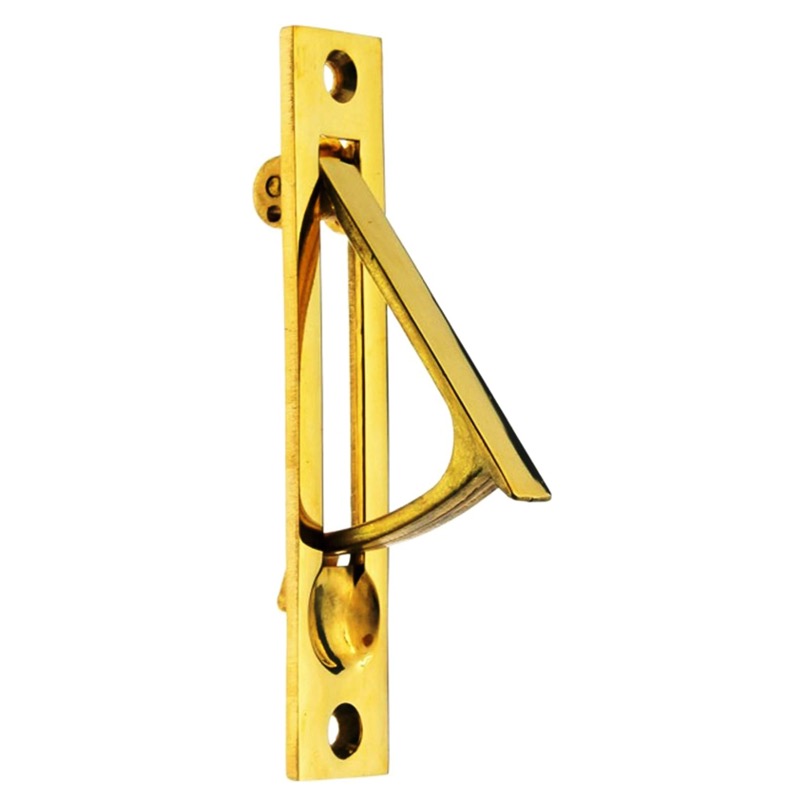
Herrajes NORTE SRL, with more than four decades in hardware for furniture and interior applications, markets a broad catalog of solutions. Among them is a direct answer to the pocket-door usability problem: the polished bronze flip pull (E-108), a ring-style pull recessed into the edge of a sliding door, designed so you can pull the leaf back out when it is inside the wall cavity (pocket configuration).
This note is not about "a pretty handle". It is about how a small component drives ergonomics, safety, durability, and even the service life of the entire sliding system.
1) The real problem: operating a slider when the leaf is inside the wall
On an exposed-track slider, a surface handle is often enough. In pocket systems, however, the point is to hide the door. That creates an unavoidable set of requirements:
- The pull cannot protrude, or it will interfere with pocket entry.
- It must provide sufficient grip for pulling, even with wet hands or gloves.
- It must resist impact and daily abuse, because it is used at the edge-the most hit-prone zone.
When the requirement is not solved, on-site improvisations appear: rough cut-outs that weaken the edge, ad-hoc notches, or people habitually pulling on the panel edge-marking finishes and weakening edge-band interfaces over time.
2) Flip (folding) pulls: why the "two-state" mechanism matters
A flip pull has two operating states:
- Flush: it sits recessed and does not stick out.
- Active: it pivots out to create a ring/loop you can hook a finger into.
This dual-state behavior is not mechanical vanity. It is the condition for living inside a narrow cavity without interference while still delivering a real pull point. A fixed, protruding handle defeats the purpose of a pocket door.
Herrajes Norte's public description positions this pull as cast bronze with a polished finish. In high-traffic hardware, material and finish are not purely aesthetic: they influence impact resistance, long-term surface behavior, and the "feel" as the pull returns to flush position.
3) Geometry and ergonomics: the door edge is a demanding interface
The door edge is a harsh user interface. Unlike a face-mounted handle, it is narrow, often operated without full visual confirmation. A recessed pull must therefore control:
- Edge radii: avoiding sharp contact points.
- Grip depth: enough clearance to engage without strain.
- Pivot travel: sufficient to pull, but not so loose that it rattles.
- Return behavior: ideally self-seating flush without slamming.
In real projects, better ergonomics also reduce complaints. If a pocket door is awkward to pull, people force the system-shortening the life of guides and tracks.
4) Installation discipline: hardware won't forgive a bad mortise
Even excellent hardware cannot compensate for inaccurate machining. Installing a recessed pull requires controlling:
- Positioning: height and edge distance based on use case (bathroom, closet, passage).
- Mortise squareness: a twisted pocket makes the pull bind or sit proud.
- Door thickness: thin leaves leave less safe material around the mortise.
- Fasteners: correct screws and, when needed, pilot holes to avoid splitting in solid wood or sensitive edges.
Typical failures include mortising too close to an end (weakening the edge) or leaving excessive clearance so the part "clacks" under use. In both cases, perceived quality drops even if the sliding hardware itself is premium.
5) System interaction: the pull as a protector of the sliding mechanism
Recessed pulls also protect the slider indirectly:
- Users stop pushing on edges and finishes.
- Pulling from the intended point improves alignment during extraction.
- Lateral stress on lower guides and stops is reduced.
In short, a correct pull choice extends stability of the whole system-especially in high-cycle environments (offices, clinics, hospitality) where a door may be operated hundreds of times per day.
6) Trends: real minimalism, not fragile minimalism
Interiors continue to move toward clean surfaces and hidden hardware, but the market has learned a lesson: minimalism cannot be fragile. That is why we see growth in:
- Pocket systems in closets, bathrooms, and room dividers.
- Better-ergonomic recessed pulls in more durable materials.
- Compatibility with melamine, lacquered, and veneered doors without damaging finishes.
In that context, flip pulls stop being "last-minute accessories" and become part of the project's technical design.
Editorial close
A well-executed pocket door is almost invisible: the leaf disappears and the space looks clean. But that "disappearance" only works if the user can retrieve the door effortlessly. That is where recessed pulls become critical. Herrajes Norte's polished bronze flip pull reflects the right idea: a small solution to a real problem-improving ergonomics, protecting the sliding system, and raising perceived quality. In joinery, the most valuable engineering is often the kind you don't notice… until it's missing.