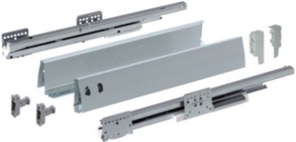

Drawers as systems: undermount soft-close slides
In furniture manufacturing, the drawer has become an instant quality test. Customers don’t measure joinery with calipers: they pull, open, load, and close. If the motion feels noisy, if lateral play is obvious, if the front shifts out of alignment, or if closing ends with a harsh impact, perceived quality collapses in seconds. That is why slides are no longer a “hardware purchase” but an engineering component: they govern user experience, influence long-term durability, and—on the production floor—define the tolerance window you can realistically hold.
Alce Herrajes SH, a wholesale supplier of hardware and furniture accessories in Argentina, offers multiple slide variants—telescopic options, full-extension formats, soft-close mechanisms, and solutions aligned with handle-less design. Within that lineup, one category stands out for modern cabinetry: the undermount soft-close slide (also described as a concealed slide with soft-close). The phrase sounds straightforward, but it actually describes a complete approach to controlled movement, consistent alignment, and quiet closing—without visible hardware.
1) What “undermount” really means—and why it raised expectations
Traditional side-mounted slides are fixed to the drawer sides and the cabinet walls. They’re durable and widely used, but the hardware remains visible when the drawer is open. Undermount slides, by contrast, install beneath the drawer: the mechanism disappears from view, the front looks cleaner, and the furniture takes on a more architectural, minimal language.
The shift is not only visual. By relocating the mechanism to the lower plane:
- Load paths change: the drawer is supported and guided from below, which can improve the “solid drawer” feel when properly adjusted.
- Alignment becomes more dependent on drawer geometry: squareness, parallelism, and accurate internal dimensions matter more.
- Installation becomes more systematic: repeatable drilling/machining references make the system more scalable in series production.
2) Soft close: the damper won’t fix a weak assembly
Soft close is often described as a simple “brake” that prevents slamming. In practice, soft-close behavior is a sequence of functions:
- The drawer is captured in the last part of its travel.
- Motion is damped through a braking module (hydraulic or mechanical, depending on the design).
- A controlled pull-in brings the drawer fully closed without impact.
For consistency, the slide must maintain a stable path. If the drawer enters skewed, if the cabinet is out of square, or if slide heights differ even slightly, the damper does not solve the root cause—it only hides it temporarily. Over time, friction, noise, and loss of smoothness appear.
The industrial takeaway is clear: soft close is not an accessory. It is a signal that the drawer, cabinet, and mounting process are inside a reasonable tolerance envelope.
3) The hidden engineering: tolerances, stiffness, and repeatability
Undermount systems demand that the drawer behaves like a controlled component—not a box assembled “close enough”. To achieve premium motion, manufacturers typically need to control:
- Drawer squareness: consistent diagonals reduce internal stress.
- Parallelism between sides and bottom: prevents the mechanism from working under constant preload.
- Bottom stiffness: with underside support, the bottom panel and its attachments become critical under load.
- Fastener quality and anchoring: wrong screws or weak substrate “creep” leads to gradual misalignment.
In CNC-oriented production, these variables become manageable: drilling patterns are standardized, assembly sequences are repeatable, and the outcome becomes less dependent on who is installing the drawer that day.
4) Installation as a process: where systems win (or fail)
The undermount soft-close promise is twofold: clean aesthetics and superior user feel. To deliver it reliably, it helps to treat installation like a checklist:
- Cabinet squareness: the drawer will follow the cabinet’s geometry, good or bad.
- Drawer sizing within target tolerances: too tight causes rubbing; too loose creates play and poor “hand feel”.
- Symmetrical slide positioning: small height differences translate into tilted fronts and uneven closing.
- Front adjustment: modern systems commonly allow fine adjustments; skipping that step wastes the value of the mechanism.
- Testing under real load: a drawer can feel fine empty and fail when loaded with cookware or tools.
When these steps are normalized, results stop depending on a “star installer” and become scalable.
5) Industry impact: perceived quality, fewer callbacks, and more design freedom
A concealed soft-close slide affects more than comfort:
- Perceived quality: quiet, stable motion reads as “premium” immediately.
- Durability: controlled closing reduces impact loads that loosen screws and damage edges.
- Less rework: adjustable systems enable correction without tearing the cabinet apart.
- Cleaner design language: hiding the slide puts material and geometry back in focus.
- Compatibility with handle-less trends: undermount solutions pair well with push-to-open concepts and integrated pulls.
For a manufacturer, that means less post-sale cost and a product that sells itself in a showroom: one open-and-close cycle tells the story.
6) Trends ahead: from “soft close” to complete motion platforms
Hardware evolution increasingly treats movement as a platform rather than a part. In drawers, this often translates into:
- Full-extension travel for total access.
- Push-to-open compatibility for handle-less fronts.
- Higher stability for wide drawers common in kitchens and closets.
- Drawer system modules (metal sides, rails, organizers) that integrate structure and slides.
- Standardized machining patterns that accelerate production and reduce variability.
In that environment, suppliers like Alce Herrajes matter not only as distributors but as specification enablers: they help manufacturers select measures, variants, and consistent availability—turning “a drawer that works” into “a drawer that always works”.
Editorial close
In furniture, the most-used detail is the one that most clearly exposes engineering. A concealed soft-close slide is not a luxury—it is a technical response to a market that expects quiet, accuracy, and repeatability. When specified and installed correctly, the user doesn’t think about it. They simply feel that the furniture is well made. And that feeling—built with steel, tolerances, and process—is one of the industry’s most valuable currencies today.