
Industrial panel surfaces: modular printing and lacquering
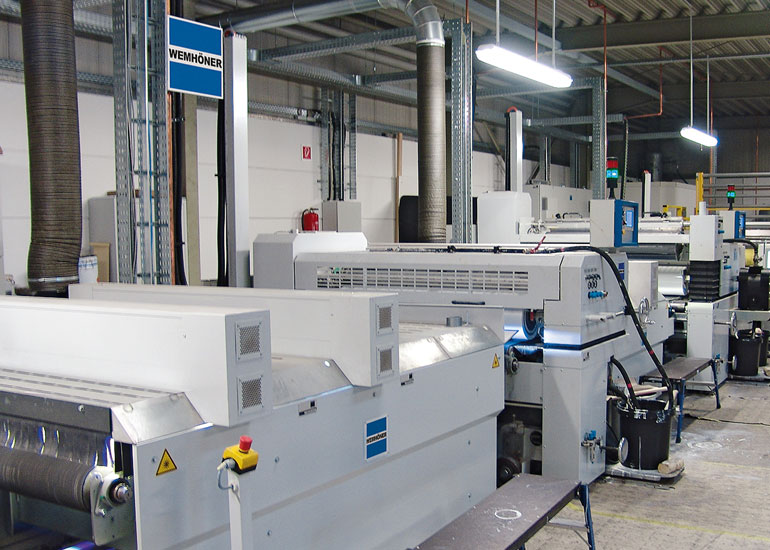
WEMHÖNER positions MasterLine as a modular architecture for lacquering and direct/digital printing on MDF and panels, designed to integrate into existing lines and deliver repeatable quality.
In furniture manufacturing, “surface” no longer means only color. A surface is a system: it defines scratch resistance, stability in daily use, cleanability, repeatable gloss, texture, perceived quality—and increasingly, the speed at which a plant can respond to short runs and frequent design changes. That is why, when a factory modernizes its offer, the discussion inevitably becomes technical: how do you turn a panel (MDF, particleboard, or other flat substrates) into a front or board with a consistent finish—industrializable and compatible with real production flow? This is where the idea of a **surface line** matters: a set of stations that prepare, coat, print, dry and cure while controlling handling and quality throughout the path. In this field, **WEMHÖNER Surface Technologies** positions its **MasterLine** family as a **modular** concept for **printing and lacquering** MDF, particleboard and other flat materials. The industrial significance is clear: modularity supports **integration into existing coating lines**, so surface upgrades do not necessarily require rebuilding the entire process from scratch. ## 1) Why a surface is a process, not a “final touch” Industrial surfaces are built through layers and process choices. Even when the market demands a seemingly “simple” finish, the final quality depends on variables best controlled in-line: application uniformity, drying/curing time, substrate stability, and consistent handling (to avoid marks and contamination). In practice, a robust surface system reduces two hidden costs: - **Rework** (extra sanding, repainting, scrap due to defects). - **Variability** (batch-to-batch differences in gloss/appearance, uneven texture, micro-contamination). Treating surface as a modular line makes sense because it turns panel finishing into a stable sequence of repeatable operations rather than a series of last-minute corrections. ## 2) MasterLine as modular architecture: integration and staged growth WEMHÖNER presents MasterLine as a product group aimed at **high-quality** yet **cost-effective** surface finishing, highlighting two ideas that read like a practical roadmap for many plants: 1) **Modules that can be combined** instead of a closed monolithic machine. 2) **Compatibility with existing lines**, enabling integration without a full redesign. This supports step-by-step modernization. A plant may start by improving handling and coating stability, then later add direct printing or digital printing based on market demand. From an investment and risk standpoint, that scalability is valuable: it allows you to target bottlenecks first without oversizing the whole line on day one. ## 3) Direct and digital printing: when design becomes data Under the motto “we create your surface,” WEMHÖNER frames MasterLine as a modular platform that can include **lacquering**, **direct printing**, and **digital printing**. This reflects a broader shift: surfaces are increasingly produced as **printed information** on the panel, supporting customization, short runs and controlled variation. In practical terms, printing becomes especially relevant when: - You want **design flexibility** without holding large stocks of decorative papers. - Your business depends on **fast-changing collections** or project-based production. - You need **consistency across parts** (fronts, side panels, toe-kicks) through stable printing profiles. The key technical insight is that printing cannot stand alone: it relies on substrate preparation and a drying/curing strategy that protects the motif and enables subsequent layers (clear coats, lacquers, protective top coats). ## 4) Drying and curing: the productivity-defining link In surface finishing, time dictates throughput. Applying a lacquer or ink is not enough; the film must become a functional layer with mechanical resistance. Drying and curing stations often determine the line’s cadence. A modular design helps right-size drying/curing according to the product requirement (gloss, matte, textured), film build, and durability targets for the final application (kitchens, bathrooms, contract interiors, high traffic). For manufacturers, the benefit is twofold: stabilized quality and reduced off-line waiting time, where handling, dust and marks become harder to control. ## 5) Surfaces depend on the substrate: presses, tolerances and consistency WEMHÖNER’s portfolio is not limited to printing and lacquering. It also includes **short-cycle press (KT) lines** and **continuous presses (Durchlaufpressen)** for the furniture and door industries. This matters because a surface line is only as good as the substrate it receives. On its KT page, WEMHÖNER emphasizes flexibility in combining surface and carrier materials and references minimal thickness tolerances even when using maximum press area. For a plant, that translates into more predictable finishing: reduced absorption variability, fewer telegraphed imperfections, and improved control over gloss and film uniformity. The continuous press offering is positioned with decades of experience and a focus on speed, reliability and economic operation for global standards in furniture and doors. The engineering takeaway is systemic: competitiveness improves when pressing, substrate quality and finishing speak the same process language. ## 6) Applications: from flat panels to 3D fronts Beyond flat finishing, WEMHÖNER also presents **3D presses** aimed at three-dimensional surface processing and the subsequent pressing of thermoplastic foils or veneers. For furniture design, this supports industrialized 3D fronts and shaped components that would otherwise demand costly craftsmanship—while still enabling a coherent surface strategy (sealers, lacquers, protective layers). ## 7) Trends: modularity, customization and repeatable quality The next stage of the market combines three forces: - **Customization** (more references, less volume per reference). - **Higher use expectations** (kitchens, commercial interiors, intensive daily cycles). - **Repeatability** (a finish must look the same today and months later). In that scenario, a modular platform like MasterLine acts as competitive infrastructure: it supports recipe changes without breaking flow, it grows by adding modules when demand justifies it, and it enables quality control through process parameters rather than manual correction. ## Editorial close In the furniture industry, the surface is the first contact point between users and a factory’s engineering. When surface is designed as a process—modular, integrable and controllable—it shifts from a rework-heavy zone to an industrial advantage. WEMHÖNER’s MasterLine concept, paired with its pressing technologies and complementary processes, aims precisely at that: turning “finish” into a repeatable, scalable operation aligned with the real speed of the market.