Invest in trees
Almost by definition, it is difficult to imagine that a city can function well thermally in summer when it accumulates temperature in the asphalt, has low soil permeability and an insufficient and uneven distribution of green. The repeated sequence consists of absorbing heat during the day and releasing it at night, a nightmare that the inhabitants of Buenos Aires go through every time a heat wave arrives, something so natural every summer.
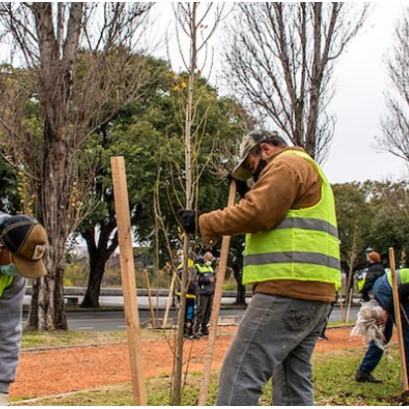
The World Health Organization (WHO) recommends a minimum of one tree for every three people in urban areas. Today in the Federal Capital that ratio barely reaches one for every 6.1 Buenos Aires inhabitants. On repeated occasions we have taken care to highlight the value of urban trees for different purposes. It is proven that greener cities not only cushion the impact of urban heat but also reduce levels of air pollution and population mortality rates. Urban vegetation also contributes to improving mental health. Areas with more green spaces have lower rates of heat-related illnesses and deaths compared to areas with fewer green spaces, particularly among groups considered vulnerable. More than 430,000 trees of 400 different species paint the city with colors and make up a natural heritage that began to grow after the time of the viceroys, according to historical accounts, with notable specimens that are even subject to special protection. Without a doubt, in terms of energy efficiency the reduction of between 5 and 8 degrees that trees provide becomes key. The parks and squares are packed with people seeking shelter when the heat gets worse. Few will dare to travel on the sunny side if there is a shadow side. And they will undoubtedly choose a boulevard lined with green rather than a street with a prevalence of concrete. A business with a tree at its door requires less energy consumption to cool its interior than one exposed to sunlight. Cooler streets suffer less asphalt deterioration. Obviously, the contribution of trees when it comes to avoiding floods is no less important, since it partially intercepts the fallen water and improves the absorption of the soil, facilitating the drainage of drains and reducing saturation and flooding. In this civilization that distances us from the healthy ancestry whose advantages we seem to have forgotten, we begin to depend on electrical energy for almost everything, increasing the emission of CO2 for the planet, postponing collective solutions to solve the conditions in a more costly and regressive way. in which we operate individually. Investing in trees is betting on greater energy efficiency. In times of technological revolution, trees are more efficient and less expensive urban cooling machines than artificial cooling machines. Unfortunately, its not all about planting to harvest and shade. They are processes that demand planning, political and economic decisions in this fundamental piece of any urban infrastructure. Selection of species, censuses, maintenance, are issues to consider. Global warming is here to stay, so investing in trees is increasingly essential not only to improve the quality of life of those of us who spend the summer in recalcitrant cities but also to reduce costs and take care of everyones health.