They promote forestation in Patagonia through irrigation with effluents
The initiative seeks to convert treated water from the Las Grutas effluent treatment plant into plant life through the production of plants intended to reforest the public spaces of San Antonio Oeste, Las Grutas and the Port of San Antonio Este.
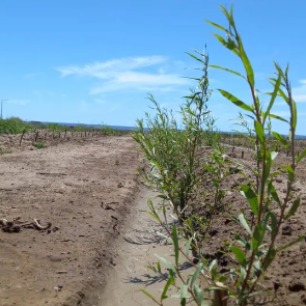
An alliance between INTA, DPA, the Municipality of San Antonio Oeste and ARSA promotes a project at the Las Grutas effluent treatment plant with the objective of reforesting with species adapted to the arid environment, revaluing public spaces and reusing water resources. This is an initiative that seeks to convert treated water from the Las Grutas effluent treatment plant into plant life through the production of plants intended to reforest and beautify the public spaces of San Antonio West, Las Grutas and the Port of San Antonio Este. Mariana Dacal Arriaga, INTA Conesa extension agent, who supports this proposal that emerged three years ago, commented that everything began as a pilot test with salicaceae—poplars and willows—to identify which clones were best adapted to soils with severe fertility limitations. Today we are in the third year of the project, with very encouraging results. The project focuses on a stake farm, a space where plants are reproduced from cuttings. Through this technique, specimens (guides) are produced that, after a year of growth, are suitable for their final destination: urban forestry. In this last year, we also added the production of ornamental species such as ash trees and aguaribay. These plants are germinated in a private greenhouse and watered with treated wastewater, rich in nutrients, to promote their development before being transplanted in public spaces, explained the extension agent. The choice of these species responds to a clear need: to improve urban trees. Those who visit our towns quickly notice the lack of green. Although progress has been made compared to previous decades, there is still much to do in terms of afforestation and shade, adds Dacal Arriaga. Once transplanted, the young plants require frequent watering in their initial phase, but later the established trees have fewer requirements. In addition to its impact on the urban environment, the project establishes a strategic link with the agricultural sector through collaboration with the Rural Society. Some specimens are tested in livestock fields, where the plants are used as shelters and shade areas for livestock, taking advantage of the abundant availability of plant material. In this context, planning for the multiplication of new species adapted to dryland conditions is planned for next year. On the other hand, Dacal Arriaga indicated that it is perfectly viable to apply this experience in other locations that have effluent treatment plants. The important thing is to adapt the system to the type of soil and local climate, and to have committed actors. Afforestation of a plaza in Las Grutas________________________________________ In this sense, one of the achievements of the project was the reforestation of a plaza in Las Grutas, carried out a year ago. A site with particularly adverse conditions for plant growth was chosen, and today the plants thrive. It is concrete proof that this model works, he affirms. Thus, this project not only greens public spaces, but also offers a concrete and replicable alternative for the efficient use of water resources, in a context of growing concern about water scarcity. We believe that we are facing a sustainable development model that combines science, institutional commitment and community participation. All this translates into more trees, more shade, more life, concluded Dacal Arriaga.