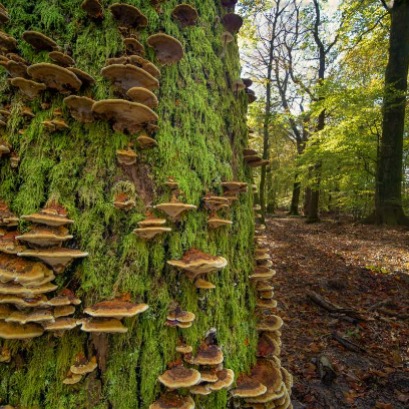
New study discovers that trees do not grow alone; Underground, their roots connect with fungi in a symbiotic relationship that allows them to share nutrients, especially in poor soils and difficult conditions
A study by the University of Zurich found that trees that form alliances with two types of fungi can better bear climate change and expand to new areas.
? Trees connect with two types of mycorrízic fungi ? This allows them mycorrízic roots and fungi. This symbiosis allows trees to exchange nutrients with fungi, increasing their resistance to adverse conditions such as poor soils or prolonged droughts. However, some species have led this strategy even further: they associate with two different types of fungi at the same time. Two fungi are better than a researchers from the University of Zurich (UZH) and the Swiss Agroscope center discovered that some trees establish simultaneous relationships Mycorrízic of different types, which improves their adaptation capacity. They ran more than 400 species of trees and found that those with double alliance were more effective facing water and nutrient shortages. The advantage is clear: having two fungal allies is like having two sources of groundwater. If one fault, the other acts as support. This dual symbiosis provides trees with a more extensive root system, allowing them to access areas of the soil that others do not reach. Territorial expansion capitability The phenomenon, nicknamed bigamy by researchers, not only improves resistance. It also allows trees to colonize new territories where other species do not survive. The root expansion facilitated by the double fungal association gives them a clear competitive advantage. It does not matter their evolutionary lineage. The relevant thing is adaptability: trees capable of associating with multiple types of fungi are more resilient, more aggressive colonizing and more effective in changing ecosystems. RESILIENCE IN FRONT OF CLIMATIC CHANGE MEASURE THAT THE CLIMATE CHANGE TRANSFORMS The selection of forest species for sustainable projects, especially in regions threatened by desertification. With a more efficient use of water and nutrients, these trees not only survive, but prosper in contexts of climate stress. Impact in ecosystems The benefit is not individual. Trees with double mycorrízic alliances also improve soils, prevent erosion, and encourage biodiversity. They become ecosystem engineers, capable of transforming deteriorated landscapes into life -rich environments. These associations strengthen the complete ecosystem, not just the tree. From insects to microorganisms, many species depend indirectly on these underground connections. And if we apply this strategy beyond forests? The finding raises valuable questions: ? How many plant species could benefit from multiple fungal associations? regenerative agriculture, ecological restoration programs and the fight against desertification.
IT MAY INTEREST YOU
 Native forest | In Misiones, controls are tightened on routes for illegal transport of native wood, logging of forests without permits and fraudulent digital guides
Informality in forestry activity in Misiones was once again evident, the culture of operating illegally is a historical problem, and the Ministry of Ecology and Renewable Natural Resources carries out the corresponding control and inspection operations in the regulation of productive activity and sustainable management for the use of native forests.
 Combilift Unveils the 2025 Christmas video “Twelve Days of Christmas” – with a Twist!
Monaghan, Ireland – November 2025
 Nation reinforces prevention and training against forest fires
The director of the Federal Emergency Agency (AFE), Santiago Hardie, referred to the support that the Nation provides in fighting fires. He argued that the majority of igneous sources respond to human interventions and that, therefore, social awareness is a central tool to reduce environmental, material and human damage.