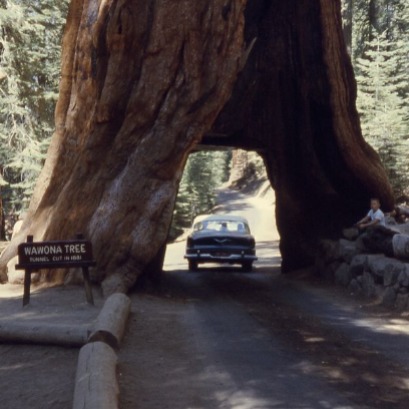
Wawona tree: the tourist attraction of the United States that disappeared in 1969
It was created in 1881 and became a very popular place during the following decades. However, when the tree fell at the close of the 1960s, everything changed. Wawona tree was the name that had a tourist attraction from the United States, which remained standing from 1881 to 1969 in Mariposa Grove, Yosemite National Park, California.
For decades, thousands of people approached the site with the intention of crossing the base of the famous tree. At first, the activity was on foot. Then, it was with cars. And finally, with cars, but everything changed 56 years ago, when the Wawona tree fell and the tunnel disappeared. How was the tunnel of the Wawona tree created? Through studies it was shown that the Wawona tree, which is described as a giant secuoya, was about 2,300 years at the time of its fall. That is why when the tunnel was created, in 1881, it was already a very old specimen. In that decade of the nineteenth century, a fire advanced on the tree. And, although it could be fought, much of its base was weakened. That is why it was planned to eliminate the affected sector, to build a tunnel and raise the tourist potential of the place. So, the Wawona tree gained popularity over time. But his great leap to fame happened after the foundation of the National Parks Service, in 1916, which coincided with the appearance of cars in California as a means of usual transport. Nearby. Why did the Wawona tree fall? 144 years ago, when the Wawona tree tunnel was created, this specimen has already experienced a slight inclination. And, although he kept standing in these conditions for almost a century, he fell during a day in February 1969. Among the reasons for his fall, in addition to the aforementioned factor, the existence of a large amount of snow was also added in his glass, product of an intense snow In the place currently? After the collapse of 1969, the United States authorities decided to leave the remains in the same place where they fell. It happens that these giant trees, over time, become homes for insects and small animals, as well as the basis for new plants. And, although it was thought that the site would not receive more visits, the opposite happened. Today, many tourists approach the huge base of the tree to take photos. That is why, currently, it is known as a fallen tunnel tree.
IT MAY INTEREST YOU
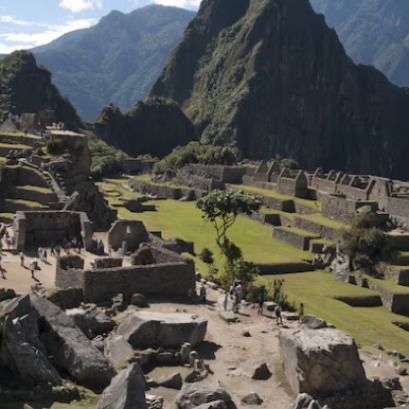 Reforestation advances in the Historic Sanctuary of Machu Picchu with new restored hectares
The plan includes the planting of a thousand new trees in the sanctuary, in response to the damage caused by forest fires and environmental threats, with the support of local authorities and representatives of the tourism sector.
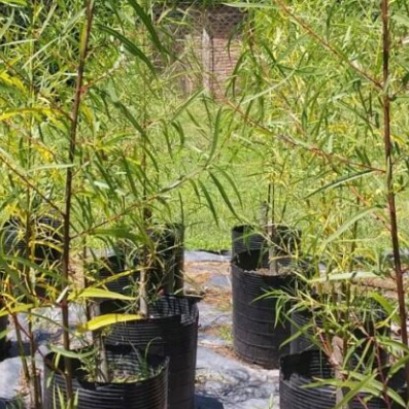 INTA Delta begins propagation of seven Creole willow clones for ecological restoration in Paraná
As a result of the rescue, domestication and registration work carried out by Teresa Cerrillo, a leading researcher in Salix Genetic Improvement, within the framework of the National Genetic and Forest Resources Programs of INTA, the multiplication and propagation of seven clones of Creole willow (Salix humboldtiana) began recently registered in the National Seed Institute (INASE) by INTA Delta del Paraná.
 The DNA of forests: they discover what makes a tree resist drought
An international team, with the participation of INTA and Conicet, discovered that genetics can be decisive for trees to better resist droughts