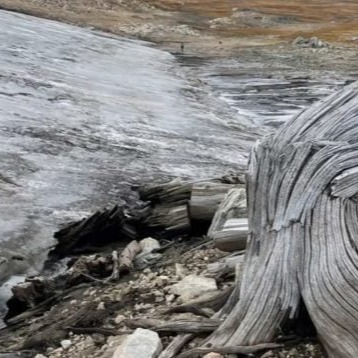
Unusual finding: a pine forest in excellent condition emerges after 6,000 years buried under the ice
In the world there are millions of forests. Some are close to urban centers, others in remote and inaccessible places, but they all fulfill a key role: maintain the balance of the planet. They are literally the lung of the earth. When talking about a new forest, the first thing that comes to mind is usually reforestation, a recent plantation or the recovery of an area razed by fire. But this discovery is on another way. It is not a forest sown recently. It is an old forest, which was there for thousands of years, buried under the ice. And now, with the thaw caused by global warming, he has emerged again.
Why does something like this happen? Because the increase in temperatures is melting layers of ice and glaciers that have remained intact for thousands of years. And when that happens, what comes to the surface is not always rock or water. The frozen forest that resurfaces after 6,000 years This forest is located in the Beartooth Plateau, a remote and high area of ??the Yellowstone ecosystem, more than 3,000 meters above sea level. There, a team of scientists found more than 30 white pine trunks (Pinus albicaulis) perfectly preserved, without cortex but with intact growth rings. According to radiocarbon dating, these trees lived between the years 5,950 and 5,440. In that time, climatic conditions allowed trees to grow at an altitude much greater than the current one. However, with the passing of the centuries, the region cooled gradually until reaching temperatures that made its survival impossible. The decrease in temperatures was due to a combination of factors: a decrease in solar insolation and intense volcanic activity in the northern hemisphere, which launched ashes to the atmosphere and blocked part of the solar radiation. However, the most striking thing is that this change was not sudden. For centuries, the ecosystem tried to adapt, until an abrupt freezing stopped everything. The trees were trapped under the ice, without margin to regenerate. And so they remained for almost six thousand years. What does this forest reveal about climate change? More than a scientific finding, this is a clear sign of where the climate is going. Today, temperatures in the rocky mountains have reached (and in some cases overcome) those of the Middle Holocene, the time when that forest existed. That could cause the trees line to rise again, displacing the ecosystem to higher areas. On the other hand, release layers of ice that have been intact for thousands of years also means exposing microorganisms and pathogens that were inactive all that time. Organizations such as the United Nations Environment Program have already warned about possible health risks. In the short term, melting could increase the water flow. But in the long term, if that ice disappears, millions of people could run out of a reliable source of water.
IT MAY INTEREST YOU
 Combilift Unveils the 2025 Christmas video “Twelve Days of Christmas” – with a Twist!
Monaghan, Ireland – November 2025
 Missions | New illegal felling in the Piñalito Provincial Park in San Pedro reveals the silent expansion of deforestation in protected areas
The advance of deforestation on protected areas was once again evident this week in the Piñalito Sur Provincial Park, in San Pedro, where the Ministry of Ecology and Renewable Natural Resources confirmed a new case of selective illegal logging. The event occurs in a context of growing concern about the fragility of the environmental control system in rural and border areas, where the scarcity of resources, personnel and logistics limits the capacity of surveillance against criminal organizations organized to steal native woods and market them on the black market in connivance with sawmill owners.
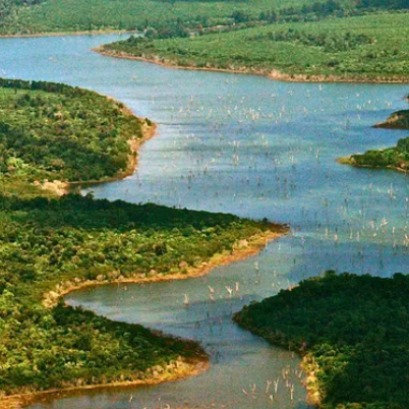 The second largest wetland in South America is located in Argentina: what is it?
Argentina has national parks that place it in a unique position within South America, competing with 300 others. Which is the largest? South America is home to more than 300 national parks, but many go unnoticed. There are extensive wetlands that have been the subject of major ecological restoration projects, to coastal mountains with deep indigenous heritage. Today we tell you the case of one located in Argentina.