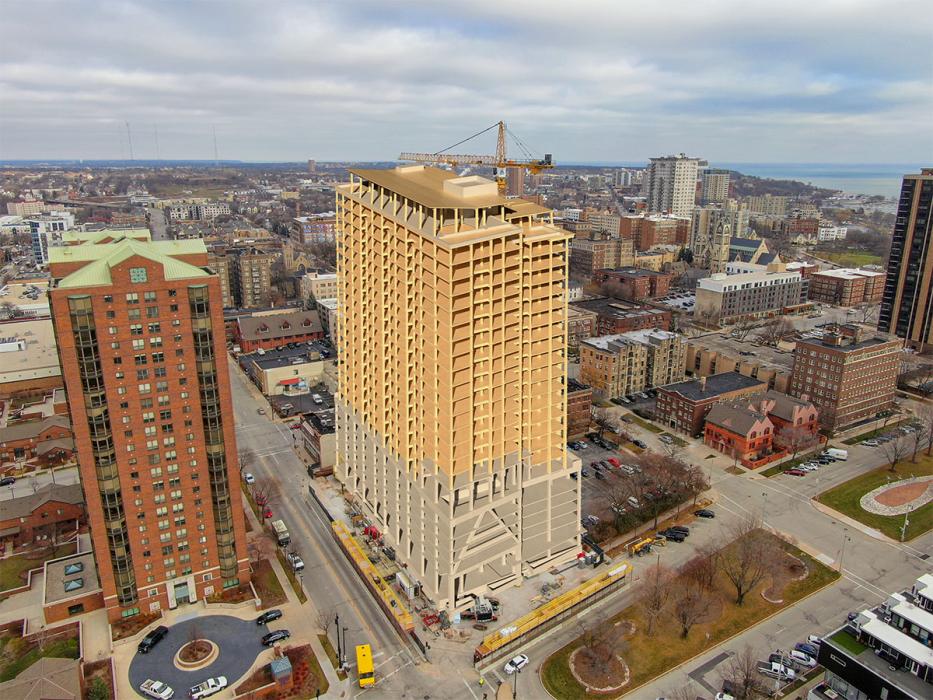
World CO2 Reduction Day | FAIMA calls on the construction industry to opt for more wood
On Sunday, January 28, in commemoration of the World Day for the Reduction of Carbon Dioxide (CO2) Emissions, the Argentine Federation of the Timber and Related Industries (FAIMA) urged the construction industry and society in general to choose wood as the primary material in current and future buildings. This invitation is made in recognition of wood's unique ability to capture carbon dioxide, along with other environmental benefits.
The global scenario presents alarming challenges with floods, droughts, extreme heat waves and climate events, underscoring the urgency of reducing CO2 emissions in a range of 28% to 42% to achieve the 2°C and 1.5° goals. C by 2030 (*).
To address this problem, the Argentine Federation of the Wood and Related Industries (FAIMA) proposes the choice of natural construction materials over those from fossil fuels as an effective tool, in addition to promoting reforestation and raising awareness about sustainable practices with low carbon emissions.
Climate change is an urgent and complex challenge, highlighting the direct relationship between the concentration of greenhouse gases (GHG), the average global temperature and the progressive increase in carbon dioxide (CO2) derived from the burning of fossil fuels since Industrial Revolution.
IN THIS CONTEXT, WOOD PLAYS A CRUCIAL ROLE BY COMING FROM SUSTAINABLE FOREST MANAGEMENT, ALLOWING THE SUBSTITUTION OF NON-RENEWABLE AND HIGH ENERGY INTENSITY PRODUCTS BY RENEWABLE AND LOW GHG EMISSION ALTERNATIVES
In line with this approach, the UN recently presented the report “Building materials and the climate: Building a new future” (**), highlighting the need to prioritize and use wood and other biological materials to reduce the degradation of ecosystems. , which could result in emissions savings of up to 40% by 2050.
Wood, from sustainable forest management, contributes significantly to the transition towards a low-carbon economy and consumption.
The ability of wood to store CO2 is not only reflected in its use in solid constructions such as furniture and flooring, but also in its ability to replace products derived from fossil fuels and with high energy demand, such as fuels, plastics and chemicals.
Daniel Vier, vice president of FAIMA and expert in wood construction, highlights the constant growth of the wood construction market in Argentina. "Wood, which was previously limited to decorative elements and rural constructions, has gained popularity in the construction of more efficient and sustainable homes," says the businessman.
WOOD NOT ONLY STORES CARBON, BUT ALSO OFFERS SOLUTIONS TO REPLACE PRODUCTS OF FOSSIL ORIGIN AND HIGH ENERGY DEMAND.
Through public policies that promote the preservation of forests, the planting of trees and the sustainable use of wood, together with the commitment of companies and citizens, progress can be made towards more sustainable construction and a circular economy.
Wood is positioned as a key choice to reduce the carbon footprint and achieve the carbon neutrality necessary to address climate change and move towards a circular bioeconomy.
Among the main benefits of using more wood as a construction material are:
• Low environmental impact of production. Wood is easily recyclable to make other products; and at the end of its useful life, it can be used as fuel.
• Wood is the only building material that stores carbon. Wood-based materials can be used in most any building to capture carbon from the atmosphere, this allows for CO2 reduction.
• Wood replaces traditional fossil fuels, providing energy with a neutral CO2 balance: the CO2 released by the combustion of wood is equivalent to the amount that the wood absorbed during its growth. Therefore, this combustion does not contribute to the greenhouse effect or global warming.
• Wood energy is “clean” because it avoids landfills and minimizes waste disposal costs. Impurities produced by combustion are filtered into the energy production units before being discharged through chimneys.
«Wood will have a leading role in the challenge of transforming large cities into more sustainable places through the bioeconomy. In fact, cities that use wood in construction become carbon capture and storage infrastructures. Even parks and the strategic location of trees around buildings reduce energy consumption in buildings for heating and cooling. Therefore, wood, trees and forests are the backbone of climate smart cities: biocities," they conclude.

IT MAY INTEREST YOU
 Native forest | In Misiones, controls are tightened on routes for illegal transport of native wood, logging of forests without permits and fraudulent digital guides
Informality in forestry activity in Misiones was once again evident, the culture of operating illegally is a historical problem, and the Ministry of Ecology and Renewable Natural Resources carries out the corresponding control and inspection operations in the regulation of productive activity and sustainable management for the use of native forests.
 INTA Delta begins propagation of seven Creole willow clones for ecological restoration in Paraná
As a result of the rescue, domestication and registration work carried out by Teresa Cerrillo, a leading researcher in Salix Genetic Improvement, within the framework of the National Genetic and Forest Resources Programs of INTA, the multiplication and propagation of seven clones of Creole willow (Salix humboldtiana) began recently registered in the National Seed Institute (INASE) by INTA Delta del Paraná.
 Nation reinforces prevention and training against forest fires
The director of the Federal Emergency Agency (AFE), Santiago Hardie, referred to the support that the Nation provides in fighting fires. He argued that the majority of igneous sources respond to human interventions and that, therefore, social awareness is a central tool to reduce environmental, material and human damage.