Scientists make an unprecedented discovery under the oldest trees in the world
This international study published in one of the most important scientific journals in the field revealed a hidden underground ecosystem.
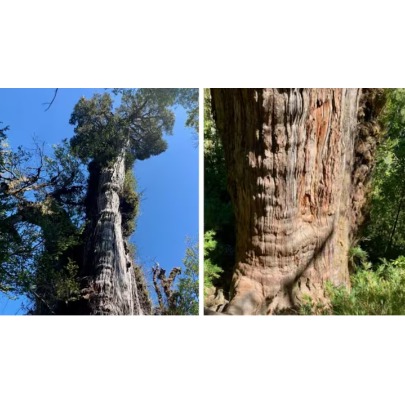
If youve ever wondered whats under a 2,400-year-old tree, the answer just changed. International research published in the journal Biodiversity and Conservation found that the oldest specimens of the Patagonian larch (Fitzroya cupressoides)—the second oldest tree on the planet—host a community of underground fungi so complex and diverse that scientists compare it with a second genome of the tree. The study was carried out in the temperate rainforests of the Coastal Mountains of southern Chile, where some of the oldest existing larches survive. The team took soil samples around 31 individual trees, from young specimens to the so-called Grandfather Larch, which is at least 2,400 years old and has a trunk more than 4.5 meters in diameter. These forests can support larch trees that are over 3,600 years old, with trunks reaching 4.5 meters in diameter. In fact, the oldest specimen on record was 3,622 years old, although it was felled in the 1970s, an example of how human action can erase in a few hours what nature took millennia to build. The invisible ecosystem found in ChileUnder the Alerce Abuelo, researchers found a fungal richness 2.25 times greater than the average for the rest of the forest, with 361 unique types of mushrooms identified. But these are not just any mushrooms. Mycorrhizal fungi, which are predominant in this ecosystem, transport water and nutrients to trees through the roots, and help plants resist water stress and pathogens. In addition, they function as conduits that incorporate carbon into the soil: at a global level, communities of arbuscular mycorrhizal fungi—the type associated with larch—move approximately one billion tons of carbon per year into the planets soils. Recent studies suggest that fungal communities associated with The roots can change with the age of the tree and even be selected by the plant itself, acting as a kind of second genome that favors its adaptation to environmental changes. A top-level scientific team The research arose from an expedition to the Alerce Costero National Park in 2022, led by scientists from the Universidad Santo Tomás, the Universidad Austral de Chile, the Universidad de La Frontera and the non-profit organization SPUN, dedicated to mapping and conserving mycorrhizal fungal networks around the world. Evolutionary biologist Toby Kiers, co-founder of SPUN, was recently awarded the Tyler Prize—considered the “Nobel of the Environment”—for her work on the importance of underground fungal networks in unique ecosystems. Why it matters beyond ChileThe climatic dimension of the discovery is decisive. The Fitzroya forests are known as the oldest and slowest growing rainforests in the world. Trees in this type of slow rainforest grow very slowly and have exceptionally low mortality, allowing an enormous amount of carbon to accumulate in the soil over centuries. Furthermore, in southern Chile, summer temperatures are expected to increase by up to 4°C and rainfall to decrease by up to 50% by 2100, making it even more urgent to understand how these ecosystems function before climate change alters them irreversibly. Warning The researchersNot all trees are the same, and if an ancient tree is cut down, the impact on all other species will be much greater than if a smaller one is removed, warned the studys main co-author. The larch is currently classified as an endangered species and faces specific threats: the destruction of its habitat, the development of road infrastructure and the increase in forest fires associated with climate change. One of the most controversial projects contemplates the construction of a route that would pass a few hundred meters from the larch forests, which would increase the risk of fires, tourist pressure and the arrival of invasive species. The message from science is clear: what is lost when a larch tree falls is not just wood or shade. It is an entire network of life that took centuries to build and that, once destroyed, has no turning back.