When the body of the trees speaks and tells its own story
Like the skin of people, the skin of woody plants also shows marks that reflect the passage of time and changes in the environment with a clarity that is impossible to hide. A persons skin speaks about them, their way of being or their daily routines. The famous crows feet awaken every smile, and show the joy made into furrows. The spots emerge over the years, many cultivated by exposure to the sun, while here and there scars from old duels can appear with time and illness, indentations that are the result of repaired damage and living tissue victorious over adversity.
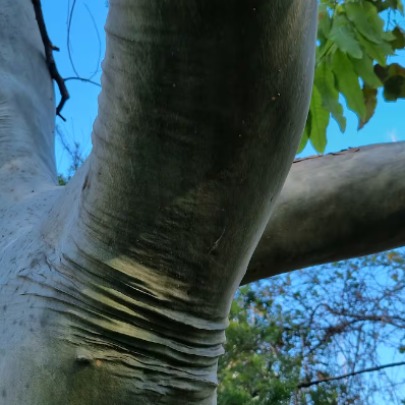
As in human beings, plant beings also show bodies in which to read their future: where the greatest amount of light that illuminates their existence comes from, the direction in which their roots have to dig to reach the water. This is more evident in plants with hardened tissues, especially in those that generate wood, that firm material that allows certain species to reach up to 100 meters in height and remain upright for even hundreds of years. Wood speaks of the problems of trees with a clarity that is impossible to hide. Sitting on a bench, facing a tree, anyone can look over the skin of the plant to read its marks and try to decipher the origin of the drawings they draw. A hackberry tree (Celtis australis) will thus show where the chainsaw has cut its lowest branches, to allow passers-by to pass without them having to bow their heads. A few steps away, a very young Japanese acacia (Styphnolobium japonicum) has had its trunk hit by several cars when they were trying to park. Without paying due attention, with successive impacts its trunk has been leaning, and the plant has to vigorously cling to the earth with its roots to overcome the feared gravity that can knock it down. This damage can be seen in its bark, as an important part of that protective shield is missing; The acacia has been generating a tissue for a couple of years that tries to cover the wound, slowly. The branches of a flowering pear tree (Pyrus calleryana Chanticleer) are oriented towards the west, since that is where it receives the most rays of sunlight and can retain its beneficial energy. On the other hand, the branches that grow towards the wall of the building are short and sparsely populated with leaves. This specimen has established a beautiful communion with other pear trees: its crowns have joined together and form a kind of continuous frond in which it is difficult to distinguish where one individual begins and another ends. Two of the pear trees, in the first row of the road, have their crowns cut by the rush of the city buses, which shape their branches with an unusual rectangular contour that corresponds to the bodywork of the vehicles. A plane tree (Platanus × hispanica) in the park, with powerful branches, shows anyone who looks up at the large amount of weight its structure supports. At the base of each branch, wrinkles appear, like an accordion, that show the pressure that the wood suffers at that exact point where the branch is anchored to the trunk. The tree, that prodigy of nature, is continually subjected to the physical demands of the climate, and each one must be prepared to face these dangers with strong and healthy wood. This is noticeable in some stone pines (Pinus pinea) in a sandy square. Subjected to the predominant wind from the south, they have gently inclined their trunks in the opposite direction, so as not to offer more resistance than necessary and for the air to lick their trunks without them offering too much opposition: the rigid and the flexible go hand in hand in the body of these conifers. When the trees encounter obstacles in their path, such as a cement curb, they have no choice but to integrate them into their body. A simple iron fence is surrounded by some cypress trees, planted a long time ago. Nobody thought that one day the diameter of its trunks would reach the metal bars, but the time has come and the wood now kisses the fence so intensely that they are now a single body. Another tree, which was born from a seed 50 years ago, germinated on a wall above the stream, enjoys its situation. Any other specimen might have fallen, but this one found a way for vigorous roots to consolidate its existence. Every afternoon, when a blackbird comes to sing in its branches, the plant observes its surroundings carefully. The same that human beings should lend to trees, to learn their language and their stories.