They created a wood that captures solar energy and continues to generate heat even at night
Chinese researchers developed a solar wood capable of storing heat and releasing it without light, with an efficiency greater than 91%. A group of researchers in China developed an innovative solar wood capable of capturing energy from the sun, storing it in the form of heat and releasing it later even when there is no longer sunlight. The advance seeks to solve one of the main challenges of renewable energy: the intermittency of solar generation and the dependence on traditional batteries to store energy.
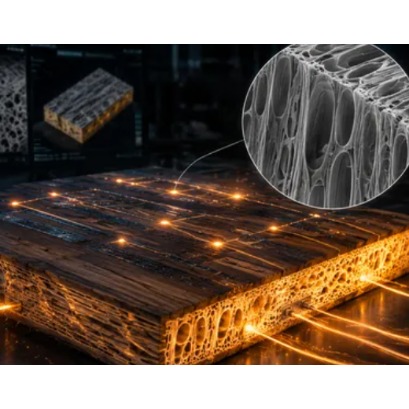
The project combines biological materials with advanced thermal storage systems and achieved record results in laboratory tests.How the new solar wood worksTo develop the material, the scientists used balsa wood as a base structure due to its high natural porosity.The first step was to remove lignin, the component that provides rigidity to wood, to transform the internal structure into a kind of microscopic scaffolding.The researchers then coated the internal channels with black phosphorene, a highly efficient photothermal material capable of convert different wavelengths of light into heat.As detailed, this compound also helps protect the material against degradation processes.The system stores heat without batteriesOne of the central points of the development is that the system does not store electricity like conventional batteries, but heat.To do this, the scientists filled the pores of the wood with stearic acid, a phase change material (PCM) that melts to store thermal energy and then gradually releases it.In addition, they incorporated a surface treatment with tannic acid, ions of iron and silver nanoparticles to improve the absorption of ambient light. The material also received a water-repellent coating to prevent damage from moisture and water. It achieved an efficiency of more than 91%. During tests carried out in solar simulators, the prototype achieved a photothermal efficiency of 91.27%. The researchers also achieved a storage capacity of 175 kilojoules per kilogram. Subsequently, they connected the wood to a small thermoelectric generator during the release of heat stored.The system managed to deliver a continuous voltage of up to 0.65 volts.What applications it could haveThe project opens the door to multiple uses linked to energy efficiency and sustainable architecture.Among the potential applications are:• passive heating systems for homes;• construction materials capable of regulating temperature;• autonomous electronic devices;• energy infrastructure for isolated areas;• and hybrid solutions complementary to traditional solar panels.The researchers maintain that this type of materials could reduce the need to use conventional chemical batteries in certain thermal applications. challenge of scaling the technologyDespite the results obtained in the laboratory, the main challenge will now be to take the technology to an industrial scale and reduce production costs. Aspects linked to durability, environmental resistance and performance in real conditions of use must also be evaluated. The development is part of the global race to create new, more efficient and sustainable energy storage technologies in the face of the growth in electrical demand and the expansion of renewable energies.