Scientists study the worlds oldest trees and find a network of unknown underground fungi
The Chilean larch (Fitzroya cupressoides) is one of the oldest trees in the world, surpassed in age only by the North American long-lived pine (Pinus longaeva). Its forests are among the slowest growing ecosystems on Earth, allowing carbon to accumulate for centuries in its soils. In southern Chile, certain specimens are over 3,600 years old.
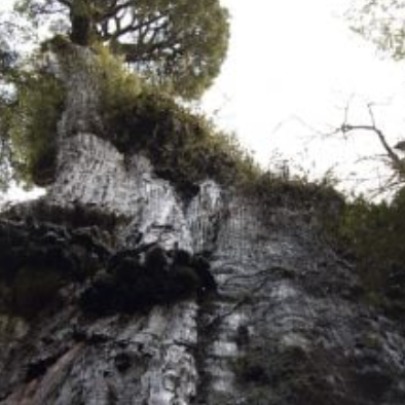
The species is listed as "endangered" on the IUCN Red List. In 2022, a team made up of researchers from four Chilean institutions and the international organization SPUN entered the Alerce Costero National Park with a question that no one had been able to answer until then: What exactly happens under the roots of the oldest tree in the forest? What the oldest trees in the world hide in the soil The researchers took soil samples under 31 individual larch trees classified into three groups: seedlings, medium-sized trees and large diameter trees. There they identified a curious network of fungi. To identify them, they used DNA metabarcoding, a technique that detects organisms from genetic fragments present in the soil without the need to grow them in the laboratory. Under the Alerce Abuelo (the oldest specimen in the park, at least 2,400 years old, 30 meters high and 4.7 meters in diameter, isolated from the rest of the population), they identified around 600 taxonomic units, the equivalent of about 600 species different fungal species. Of them, 361 were exclusive to that tree: they did not appear under any other specimen in the study. The fungal richness in the vicinity of Grandfather Alerce turned out to be 2.25 times higher than the forest average. Arbuscular mycorrhizal fungi (those that form a direct symbiosis with the roots) were 1.75 times more abundant than in younger larch trees. The study was published in March 2026 in the journal Biodiversity and Conservation under the direction of Camille Truong, from the Royal Botanic Garden Victoria in Australia, and Adriana Corrales, from SPUN. The underground network of fungi that keeps the ancient forests of Chile aliveMycorrhizal fungi establish with the tree a mutually beneficial relationship. They integrate into the root cells and deliver phosphorus and other nutrients that they extract from the soil to the larch tree; in exchange, the tree gives them carbon. This alliance, built over centuries, generates underground networks of mycelium of enormous complexity that connect different organisms in the forest. On a global scale, mycorrhizal fungi transport around 1,000 million tons of carbon per year from the roots to the soil. Of the approximately 25,000 mycorrhizal species estimated to exist on the planet, only about 1,500 are known. The study on larch suggests that a good part of this hidden diversity may be concentrated under the oldest trees in the world: the larger and older the tree, the more complex and exclusive the fungal community it houses. Why is cutting down the larch, one of the oldest trees in the world, a loss that cannot be replaced? The researcher Adriana Corrales puts it bluntly: an ancient larch cannot be replaced even with 10 young trees. The reason is direct: when such a tree disappears, the hundreds of species of fungi that lived in symbiosis with its roots have nowhere to go. Mycorrhizae do not survive without their host and, when they die, they release into the soil the carbon that they had stored for decades. Patricia Silva-Flores, another of the teams researchers, emphasizes that larches function as reservoirs of fungal biodiversity: The older the specimen, the greater the diversity there is around it. Losing a 2,400-year-old specimen is not just losing a tree; It is dismantling an underground ecosystem that took millennia to form. Camille Truong adds something that the data itself makes difficult to ignore: Not all trees are the same. If such a tree is cut down, it cannot be replaced. The species is already classified as endangered and less than half of its territory has legal protection.