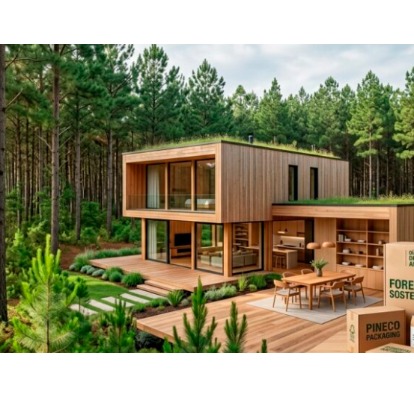
World Environment Day | The forest-industry as a strategic ally for climate action and sustainable productive solutions
Every June 5, World Environment Day invites us to reflect on the concrete actions that can contribute to building a more sustainable future. The Argentine Forestry Association (AFoA) adheres to the 2026 proposal, in which the United Nations focuses on climate action, a challenge that requires the commitment of governments, companies and citizens, but also the promotion of productive sectors capable of generating solutions based on nature.
In this context, the forestry sector is positioned as a strategic ally. Through the sustainable management of forest resources, it contributes to capturing carbon, protecting ecosystems, generating renewable products and promoting economic development in numerous regions of the country. Trees capture carbon while they grow. One of the main contributions of forests is their ability to absorb carbon dioxide from the atmosphere through photosynthesis. During their growth, trees capture and store carbon in their wood, branches, leaves and roots, thus contributing to global climate action efforts. Afforestation and the sustainable management of plantations allow this natural process to be enhanced, transforming forest systems into important carbon reservoirs. Wood stores carbon in the long term. The forest contribution does not end when the tree completes its growth cycle. When wood is transformed into homes, furniture, packaging, floors or different products for everyday use, the captured carbon remains stored for years and even decades. This makes wood a material with a differential characteristic: in addition to being renewable, it can act as a long-term carbon reserve, extending the environmental benefits far beyond the forest. Substitution of higher impact materials with forest-based products Wood and other products derived from forestry activity can replace materials of fossil origin or production processes with a greater environmental footprint. From construction and From design to packaging and the generation of bioenergy, forest products offer renewable alternatives that allow us to move towards more sustainable production and consumption models. Furthermore, the development of new technologies and biomaterials increasingly expands the opportunities for wood to participate in strategic sectors of the economy. Production and conservation can move forward together. Sustainable forest management promotes a long-term vision that integrates production, conservation and territorial development. Responsibly managed plantations and forests contribute to protecting soils, conserving water resources, promoting biodiversity. and generate employment in numerous communities, especially in regions where forestry activity constitutes an engine of economic growth. In Argentina, the forestry sector works under increasingly demanding sustainability standards, promoting practices that make it possible to make production compatible with the care of natural resources. A concrete tool for climate action Climate action requires multiple solutions capable of generating positive impacts in the short and long term. On this path, forests and the forestry sector have a relevant role because they combine carbon capture and storage, production of renewable materials, conservation of natural resources and economic development. On World Environment Day, the forestry contribution demonstrates that it is possible to promote productive activities that, at the same time, contribute to building a more sustainable future for the next generations, AFoA concludes.