Integrated light without visual noise: recessed LED profiles as technical components
In furniture and interior architecture, lighting stopped being "a fixture" and became a design layer. The difference shows up in one detail: when light is integrated into cabinetry without visual clutter, the space feels cleaner, more precise, and more useful. But that integration is not achieved by simply sticking an LED strip "where it fits". It is achieved by treating light as a system: mechanical support, optical diffusion, thermal behavior, wiring, serviceability, and installation tolerances.
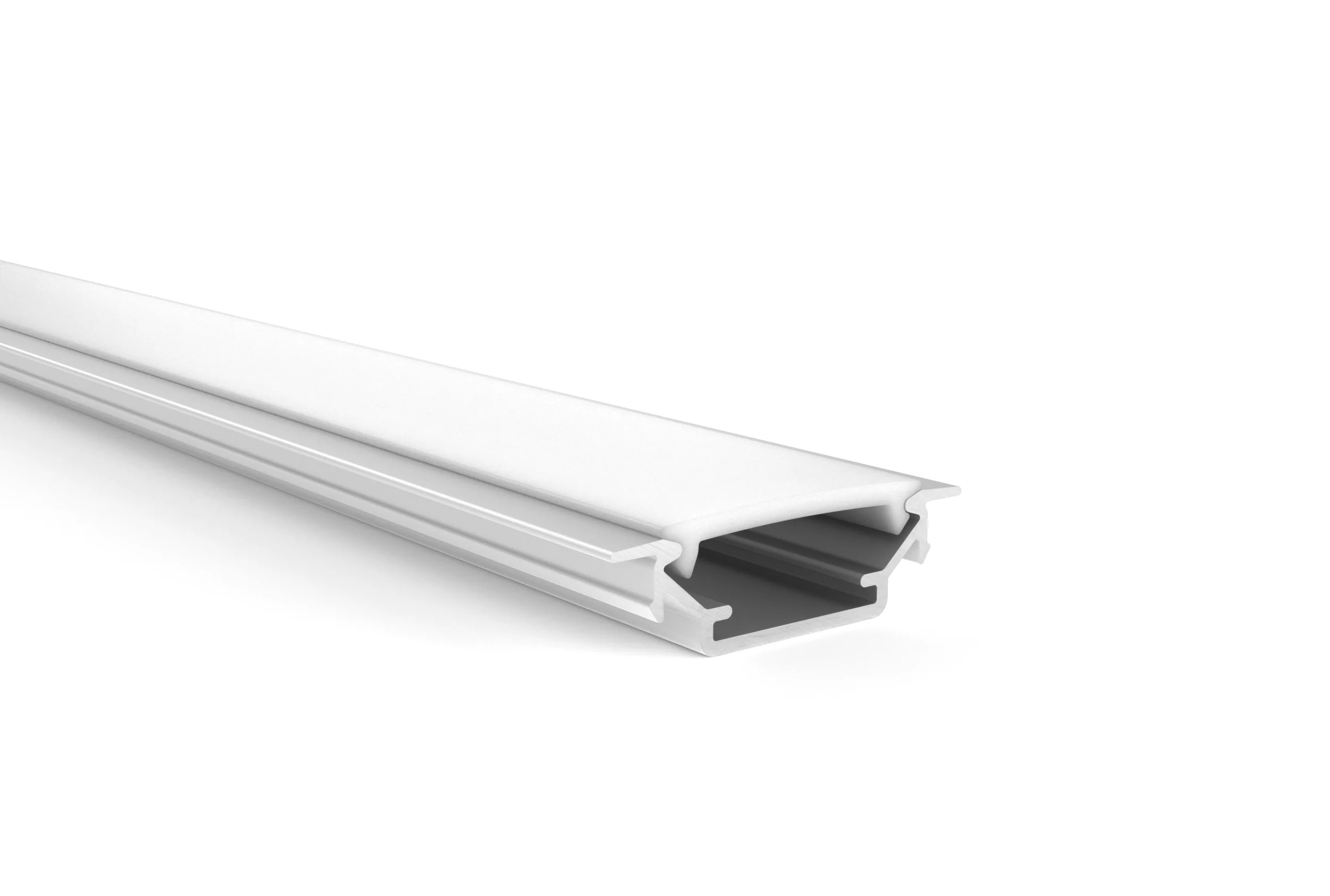
Within that context, Grupo Euro offers solutions for interior fit-out and presents the PLE (Perfil Led para Embutir / recessed LED profile) in its catalog: an indoor-use aluminum profile with diffuser, available in anodized or black finish, supplied in 3-meter lengths. At first glance it can look like a small accessory. In practice, a profile like this defines the real performance of a linear light: how it looks, how long it lasts, and how repeatable the installation is.
This technical note uses PLE as a case to explain why an aluminum profile is not just a "strip holder", but an industrial component that organizes process and improves final quality.
1) The problem it solves: linear light without hotspots, visible wires, or improvisation
Linear lighting in cabinetry appears in kitchens, closets, shelving, media units, and retail displays. The request is almost always the same:
- A continuous line (not a string of dots).
- No glare when viewed from the front.
- Hidden and protected wiring.
- Easy maintenance (strip replacement, diffuser cleaning).
Without a profile, an LED strip stuck under a shelf is exposed: the LED points are visible, dust builds up, adhesive can fail over time, and thermal dissipation is poor. With a recessed profile, light becomes part of the furniture: it is housed, protected, and controlled.
2) Applied optics: the diffuser is an engineering part
PLE is offered with a diffuser, and that word carries weight. A diffuser is not a plastic cover "to hide the strip". It is an optical element that defines:
- Uniformity: reducing the "dotting" effect of individual LEDs at short viewing distances.
- Glare control: lowering direct luminance toward the eye.
- Appearance: turning a strip into a smoother luminous line.
Perceived quality in illuminated furniture depends heavily on the diffuser. A high-end LED strip with poor diffusion still looks cheap. Conversely, a correct diffuser can elevate an average installation to a professional result.
Technically, LED spacing, profile depth, and diffuser opacity must be specified together. If the strip has low LED density and the profile is shallow, diffusion may be insufficient. That is why the profile's geometry and the selection logic matter.
3) Thermal behavior: aluminum is not aesthetic, it is service life
In LED systems, temperature is the boss. Higher junction temperatures reduce lifetime and accelerate lumen and color shift. Even efficient LEDs generate heat; if it cannot be evacuated, the system ages faster.
An aluminum profile acts as a passive heat spreader: it receives heat from the strip (through the adhesive/tape interface) and distributes it. This does not turn cabinetry into an "industrial heatsink", but it does improve thermal balance compared to strips bonded to melamine, MDF, or plastic edging.
In kitchens-where ambient conditions vary-better thermal behavior translates into fewer premature failures and fewer replacements. The industrial outcome is simple: less maintenance and fewer complaints.
4) Mechanics and tolerances: recessing is a precision operation
Recessed profiles require a woodworking operation: routing a channel. Done correctly, it improves repeatability. Done poorly, it creates assembly and aesthetic issues.
Key control points include:
- Channel width and depth must match the profile and diffuser geometry.
- Straightness matters: waviness becomes a wavy light line.
- Diffuser seating: a proud or tilted diffuser creates shadows and steps.
- End details: clean cuts and end caps so the installation does not look improvised.
Using 3-meter lengths is also a production advantage: fewer joints in long runs (upper cabinets, shelving, continuous lines). Fewer joints typically mean fewer weak points: fewer shadows, fewer discontinuities, less variability.
5) Finish options: anodized vs black (when color is functional)
Grupo Euro lists anodized and black finishes. In integrated lighting, finish is not only about style:
- Anodized integrates well with aluminum, stainless, and light palettes.
- Black helps the profile "disappear" in darker furniture and emphasizes the luminous line.
Black can also reduce internal reflections, improving perceived contrast in some applications. Anodized surfaces offer good durability and stable appearance over time.
6) Typical applications: kitchens, closets, shelving, retail
Recessed profiles with diffusers add value in:
- Kitchens: under-cabinet task lighting, niches, and interior modules.
- Closets: frontal/lateral lighting that avoids glare.
- Shelving and media units: clean auxiliary light with hidden wiring.
- Retail displays: consistent "scene" control across repeated modules.
In all cases, the profile organizes the build: where wiring runs, how the strip is mounted, how cleaning works, and how replacement is performed.
7) Trend direction: light as furniture architecture
The trend is to integrate light into furniture as a structural design choice, not a late add-on. That drives:
- More discreet recessed profiles.
- Diffusers capable of uniformity even in low-profile geometries.
- Serviceable systems that do not require dismantling furniture for maintenance.
- Better coordination between woodworking (channels, tolerances) and electrical design (drivers, dimmers, sensors).
In that environment, products like PLE become the interface between two domains: cabinetry (routing, fit, finishing) and lighting (optics, thermals, power).
Editorial close
A well-integrated light line does not read as a "fixture". It reads as quality. A recessed LED profile with diffuser-like Grupo Euro's PLE-turns a strip into an industrializable system: more uniform, more durable, and easier to install with repeatable results. In a market where differentiation lives in details, integrating light with technical discipline is one of the most direct ways to improve both perceived quality and service life.