The South American tree that launches its seeds 100 meters in an explosion audible several meters away
A natural mechanism of this South American tree allows it to project its seeds with such force that they reach great distances In the humid forests of South America, where light filters through dense layers of leaves and the air always seems charged with life, there are survival strategies of certain trees that defy human logic.
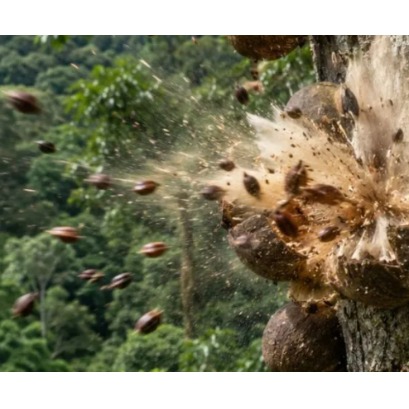
One of the most surprising belongs to a species native to Brazil, the Hura crepitans, a tree that has perfected a form of reproduction that is as violent as it is efficient. It is about the explosive dispersal of its seeds. We will tell you why it resorts to this very particular strategy. The native South American tree that launches its seeds 100 meters in an explosion audible several meters away At first glance, this tree from the South American region may seem like one more within the tropical landscape. Its robust trunk and large leaves do not anticipate the spectacle hidden inside. However, when the fruits of this species ripen, a fascinating physical process occurs. The woody capsules dry out progressively, accumulating internal tension in their tissues. This pressure, a product of the uneven dehydration of the fruit walls, reaches a critical point. And then it happens. The explosion of this tree is sudden, sharp and audible. It can be heard several meters away, like a loud snap that breaks the silence of the forest. It is not a smooth or gradual event. It is an instantaneous release of mechanical energy that turns each seed into a small projectile. Under favorable conditions, these seeds can be expelled at distances ranging from tens of meters, reaching in some cases close to 100 meters from the mother tree. A versatile tree: from its anatomy to its traditional uses This mechanism is not a coincidence, but rather a highly specialized evolutionary strategy. In ecosystems as competitive as the South American rainforest, staying close to the parent tree means competing for light, water and nutrients at a disadvantage. By being thrown over long distances, the seeds increase their chances of colonizing new spaces, reducing direct competition and favoring the expansion of the species. • It is a tree that can reach between 4 and 35 meters in height, with a trunk that usually has sharp thorns, especially at the base. • Its leaves are alternate, with a petiole that has glands at the end. The blade is simple and has an ovate to ovate-delta shape.• The staminate flowers are small (3 to 5 mm), without floral disc. The calyx is completely united, forming a cup-shaped structure with a truncated edge. It does not have petals. It has numerous stamens with anthers organized in whorls on a central column, and lacks a pistiloid.• Its wood is used in general carpentry, interior construction, packaging, veneers and low-cost cabinetmaking, and is also useful as a filling material due to its lightness.• Its latex is toxic to fish, which can make them sleepy, which is why it has been traditionally used to facilitate their capture. Despite this, some birds such as parrots and certain monkeys consume its fruits and seeds, especially when they are tender.•