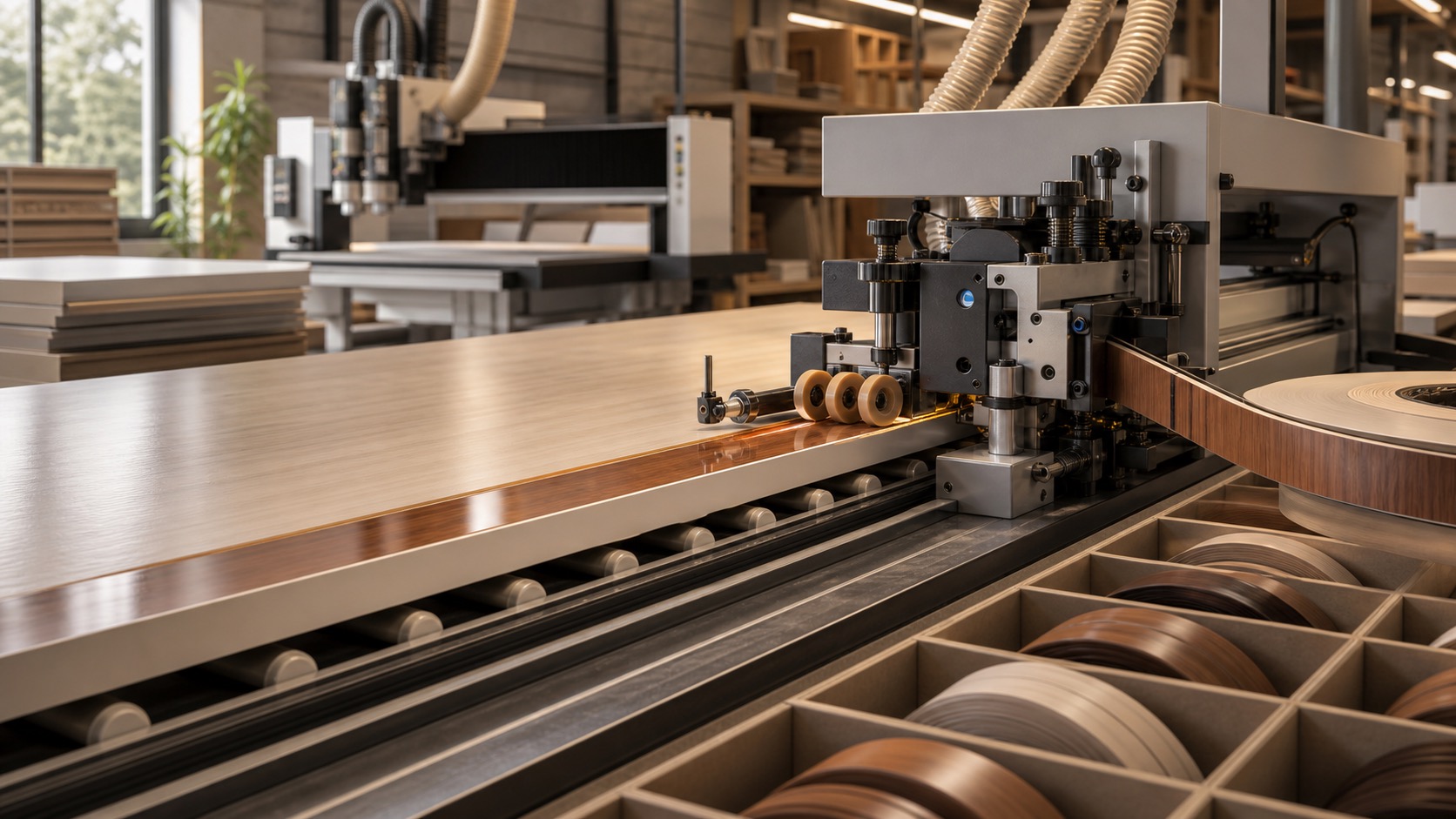
Edge banding without downtime: why edgebanders are becoming a strategic bottleneck in panel and furniture production
Recent updates in edgebanding machine portfolios and their push toward digital integration highlight an industry shift: cutting fast is not enough if the edge cannot keep up. Edge banding concentrates perceived quality, energy use, adhesive chemistry, setup time and traceability-so it is being redesigned for shops and plants with increasingly industrial expectations.
For years, in many workshops, edge banding was the station you "managed" with experience, patience and a spare part within reach. The edge was treated as a mix of craft and luck: part machine, part temperature, part glue, part pressure-and finally the operator's hands. But melamine-faced panels, MDF and decorative laminates became the default of contemporary interiors, and with that default the bar moved. Edge quality stopped being a detail and became a marker of brand, durability and compliance. In that context, the category's recent evolution-portfolio consolidation, technical upgrades and industrial connectivity-works as a signal of where the industry is heading. In late April 2026, Altendorf announced it is consolidating its edgebander portfolio under a single brand, revising two lines aimed at distinct applications, and preparing machines for connection to an IIoT platform. Beyond any manufacturer, the underlying point is general: edge banding is no longer "just another machine." It is increasingly a process decision. ## The edge is a system-critical operation In furniture and interior panels, the edge performs three jobs at once. First, aesthetics: a clean edge defines perceived quality. Second, function: it seals the substrate, improving resistance to humidity, impact and wear. Third, industrial discipline: it is an operation that concentrates variability because it depends on temperature control, cleanliness, calibration, speed and the correct adhesive. That is why edge banding often becomes the bottleneck. A shop may have fast saws and CNC capacity, but if edging cannot match the takt time, parts pile up, handling increases, and the risk of damage and rework grows. When flow breaks, the cost shows up not only as lost minutes, but as real defects: delamination, visible glue lines, scratches from mis-set scrapers, or finishes that fail under everyday use. ## What is changing in edgebanders (and what it means) Innovation in edge banding is not one single breakthrough; it is a set of improvements aligned around three goals: reduce setup time, increase consistency, and lower process energy/maintenance burden. 1) Faster start-up and better thermal stability. Consistent edges require controlled heat. In shops with frequent changeovers, shorter warm-up times and stable thermal components translate directly into throughput: less waiting means more flow. 2) More "one-pass" finishing. The value leap is often moving from basic edging to a fully finished edge in a single pass: gluing, pressure, trimming, milling, corner rounding, radius scraping, surface scraping and polishing. Done well, that reduces rework and increases repeatability. 3) Cleaner operation and reduced maintenance friction. Dust and glue are permanent enemies. Designs that simplify maintenance, improve extraction and reduce manual adjustment points help sustain quality without relying on "heroes" in the shop. 4) Energy-saving modes and idle-time management. Glue pots and heaters consume energy and can degrade adhesives if kept hot for long periods. Automatic eco modes and smart shutdown logic reduce operating cost and help process stability. ## Adhesives, emissions and tighter requirements Edge banding sits at the intersection of productivity and chemistry. The industry balances EVA and PUR systems, multiple edgeband materials and thicknesses, and customers demanding higher durability. The trend is clear: more performance, fewer visible defects, and better emissions control. This ties to two broader debates. The first is indoor health and environment: specifications increasingly require lower odor, lower VOC emissions and cleaner plant practices. The second is traceability: when an edge fails, the question is not only "what happened?" but "which lot, which setup, which operator, which temperature profile and which adhesive recipe?" ## Digitalization: edging joins the control room IIoT connectivity in edgebanders is not a luxury feature-it answers a practical need: if the edge is critical, you need to measure it. With machine data (states, stops, parameters, consumption), manufacturers can detect failure patterns, justify preventive maintenance, compare shifts and reduce variability. In more industrialized panel and furniture plants, digital integration also supports flow between cutting, CNC and edging. The goal is straightforward: continuous production where each part reaches the edgebander with the correct "recipe" (material, edgeband thickness, adhesive system and machining stations to activate). ## Industry impact: visible quality and real efficiency Edge banding is where quality is seen. A buyer may not recognize an excellent CNC toolpath, but will notice a poor edge instantly. That is why edging investments pay back commercially. The operational payoff is just as strong: less rework, fewer complaints, lower edgeband and adhesive waste, and better use of labor. For mid-sized shops, the key win is often reducing changeover errors-moving from "by feel" adjustments to repeatable presets. For large plants, the key is line balancing, so edging does not cap the capacity of cutting and machining. ## What's next: less magic, more method Over the next few years, the category is likely to move in three directions: - More automated setup (presets, fewer manual interventions, less operator-to-operator variation). - Built-in quality verification (sensing and checks closer to the process, not only at final inspection). - Smarter energy management (heating control, idle-time strategies and cleanliness routines). ## Editorial close The edge is the detail that defines the whole. Edge banding is not "finishing work"-it is a chemical-mechanical process where perceived quality, durability and throughput are decided. That is why the industry is redesigning edging with industrial logic: less dependence on individual skill, more repeatability, more data and less wasted time. For the wood and furniture value chain, the message is simple: when the edge keeps up, the rest of the flow is released. And when the edge becomes reliable, the business becomes more reliable too.