From scrap to prototype: open labs that turn wood waste into materials and components
A Milan Design Week 2026 initiative points to an industry shift bigger than any single brand: manufacturers and designers are starting to treat workshop waste as design feedstock-using digital workflows, CNC and data. The lab stops being a showroom and becomes innovation and training infrastructure.
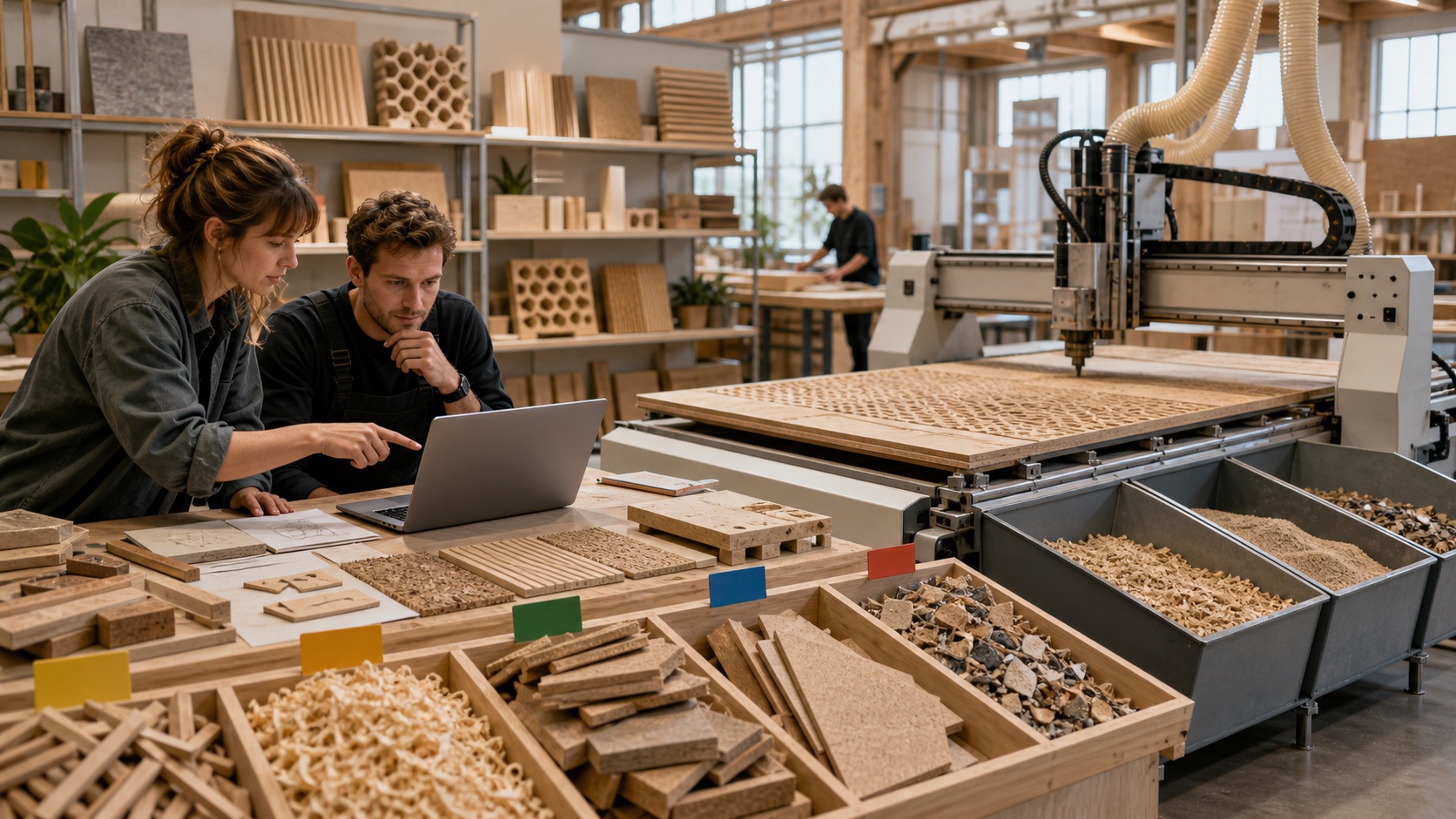
Wood is entering a decade in which performance is no longer measured only in cubic meters processed. It is also measured in how well a company-or a city-can manage what it used to call "waste." Shavings, offcuts, out-of-tolerance parts, leftover panels, mixed streams no one wants to sort: they exist in huge volumes and yet rarely show up in strategic conversations. Waste appears at the end, as a cost. But a quiet trend is moving the problem toward the beginning: designing and manufacturing with material return in mind. That shift became particularly visible in Milan during Design Week 2026. Between April 19 and 26, an advanced public woodworking lab-mixing exhibition and hands-on workshop activity-proposed a practical exercise: reuse and "regenerate" wood-processing waste into new materials and components, supported by CNC machining and digital tools. This is not merely cultural programming. It is an industrial signal: when waste is discussed in prototyping environments and connected to machines, software and standards, it stops being a disposal topic and becomes a competitiveness topic. ## The real pivot: turning "scrap" into a specification-grade input For waste to become feedstock, it must first become predictable. In a real shop floor, discard streams are not homogeneous: they vary by species, moisture content, coatings, adhesives, dust and contaminants; and they vary by process (cutting, drilling, sanding, edging). The first step of circularity is not at the press or the energy boiler-it is in sorting, measuring and recording. That requires a different mindset. Instead of asking "where do we dump it?", a shop begins to ask: - What waste fractions do we generate (chips, fibres, panel offcuts, fine dust)? - Which contaminants appear (melamine layers, plastics, metals, paints)? - How does it behave (bulk density, particle size distribution, moisture)? - Which applications tolerate variability and which require tight control? Once those questions are answered, options more valuable than energy recovery become realistic: acoustic products, fillers for composites, technical panels, 3D-textured design parts, or components built directly from "new" mixtures of fibres and particles. ## Technology as the bridge: CNC + software + method The second part of the shift is technological, but not in the "automation for automation's sake" sense. Technology acts as a bridge between waste and value because it enables repeatability. In prototyping contexts, a CNC machine can take a non-standard material and turn it into a component with tolerance. Software can document the process, version files, record parameters and learn from failure. In practice, circular wood waste needs three capabilities the industry already has-yet seldom applies to discard streams: 1) Material preparation. No component exists without preparation: drying, conditioning, screening, mixing, compacting or bonding. What is new is treating that preparation as part of the workflow, not as an improvised side activity. 2) Design-for-manufacture. A circular prototype cannot be a whim. It must respect machining limits, dimensional stability and material behavior. That pushes designers and technicians to collaborate earlier and more tightly. 3) Quality control. If the goal is to leave the lab and enter the market, you have to measure. "It looks good" is not enough: you need to understand strength, odors, dust release, joint durability and finish compatibility. An open lab that combines exhibition and workshop activity accelerates this method because it forces teams to document, explain and repeat in front of others. That, in itself, becomes a form of standardization. ## Industry impact: circularity that doubles as a quality discipline In the wood ecosystem, circularity is often communicated as a "good practice." For manufacturers, it can be an operational advantage. Reducing waste is not only about reducing trash; it is about reducing variability and hidden costs. In panel plants, furniture shops and industrial joinery, waste is frequently a symptom of deeper issues: poor cutting plans, insufficient precision, excessive rework, weak moisture control, or design decisions that do not match the factory. When waste is treated as feedstock, those inefficiencies become visible. Waste stops being invisible: it is measured, labeled and discussed. The interesting side effect is that the quality of the "non-waste" output improves too. If a company learns to control discard fractions, it tends to control its main process better. There is also a market lens. Interior and furniture buyers increasingly pay for verified origin and impact stories-but only when they are backed by performance: no warping, no persistent odors, low emissions, reliable joints. Circularity without performance becomes a problem. Circularity with performance becomes a differentiator. ## What's next: education, co-development and "material ecosystems" The third part is cultural. An open lab-where students, designers and professionals share machines and prototypes-functions as an interdisciplinary school. In wood, that interdisciplinarity is essential: there is no real circularity if design ignores adhesives and pressing, if the shop ignores coating chemistry, or if operations ignore dust and safety requirements. In the coming years, expect more initiatives with three traits: - Labs as public or semi-public infrastructure, where waste-based materials are tested using real industrial equipment. - Co-development projects linking universities, designers and manufacturers around concrete applications (acoustics, interiors, components). - "Material ecosystems" where waste from one process becomes feedstock for another, with logistics organized to maintain volume and quality. This does not replace industry; it complements it. It is the place where uncertainty gets reduced before investment. And in a time of high costs and stricter requirements, reduced uncertainty is a competitive advantage. ## Editorial close: waste is not the end-it is the feedstock we failed to name For decades, wood's narrative was powerful: renewable, warm, versatile. Today it needs a new layer: governable. Governable means the industry can demonstrate control over quality, emissions, safety-and also over discard streams. Open labs that turn waste into prototypes are not design curiosities. They are rehearsals for a more mature wood economy-one in which value is not lost at the end of the process, but reinvented with method. When waste becomes material, the question stops being "what do we do with leftovers?" and becomes "what new products can what we already have enable?"