Advanced MDF recycling: circular fibre moves toward industrial scale
Smarter sorting, deeper decontamination and tuned formulations are making post-consumer fibre viable again—reshaping supply resilience for panel makers.
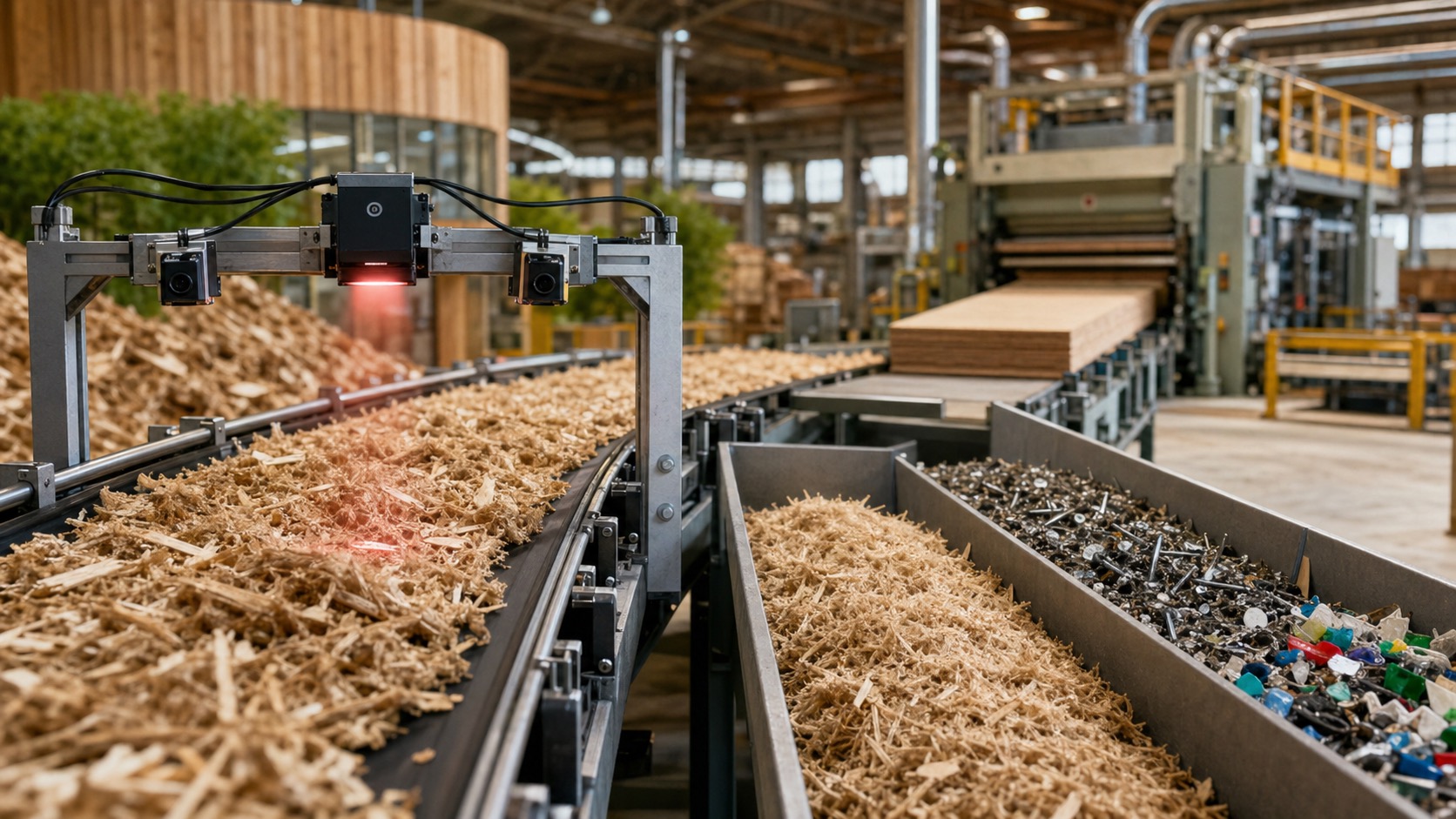
For a long time, the end-of-life story of MDF and other fibreboards was the awkward part of an otherwise successful value chain. While solid wood can often be reused or downcycled with relative ease, fibreboards bring a more complex mix to the table: wood fibres bonded with resins, additives, and layers of coatings that vary from one product to the next. In practice, that complexity pushed a large share of discarded fibreboard toward energy recovery, simply because “recycling it back into boards” was costly, hard to control, and uncertain in quality. That certainty is starting to break. Europe is tightening its circularity agenda, and—crucially—the enabling technologies are beginning to solve the toughest bottlenecks in fibre recovery. A recent signal came from Brussels: on March 25, 2026, a policy conference titled “Unlocking Circularity and Market Potential from Wood Waste” brought together more than 70 experts from policy, industry, and civil society around a common thesis—recovered wood is no longer a side-stream, but an increasingly strategic input for resilience, competitiveness, and lower-impact manufacturing. ## What is changing on the factory floor (and why it matters) Recycling MDF is not the same as recycling solid wood. Fibreboards combine fibres with binders, and often come from furniture, interiors, and construction, each with their own chemistry and contamination patterns. Paints, laminates, metals, plastics, mineral residues, and moisture variability are not edge cases—they are the default conditions of real-world waste streams. That is why the “easy route” historically was to shred and burn. The emerging shift is being driven by three technical pillars: smarter sorting, deeper decontamination, and fibre-recovery processes engineered to run reliably at industrial scale. 1) Smarter sorting and a move toward traceable inputs. If a manufacturer wants secondary fibre that behaves consistently, the first battle is at the gate. Manual sorting cannot keep up with the diversity of post-consumer material, and classical mechanical sorting struggles when the goal is specification-grade fibre. Newer approaches combine sensor-based identification (for example, near?infrared and camera systems) with algorithmic classification to separate streams by material family and contamination levels. In parallel, the industry is revisiting traceability: product data carriers and “material passports” are not just policy buzzwords; they are mechanisms to reduce uncertainty and stabilize supply. 2) Pre-treatment as a quality stabilizer, not an afterthought. Before fibre recovery even begins, the waste needs to be processed in ways that make the downstream steps predictable: removing metals, screening and fractioning particles, separating unwanted fines, reducing plastics and mineral contaminants, and building homogeneous lots. This unglamorous layer is where many failures are decided—unstable feedstock leads to unstable boards, regardless of how advanced the press line is. 3) Fibre recovery: reopening the board without destroying the fibre. MDF fibres have already been exposed to heat and pressure and locked into a resin matrix. Recovering them means breaking that structure apart and conditioning fibres so they can be reprocessed. The challenge is twofold: preserve enough fibre integrity to meet mechanical performance targets, while also controlling emissions and ensuring compatibility with new resin systems. Industrial routes tend to combine thermo?mechanical steps with carefully controlled chemical or process conditions that facilitate separation without excessive degradation. 4) Reformulating the board: recycled content is a design variable. Even high-quality recovered fibre will not behave exactly like virgin fibre. It can differ in bulk density, fines content, and resin uptake. The practical implication is that “recycled MDF” is not produced by simply swapping inputs; it requires tuned recipes, moisture management, press curves, and blending strategies with virgin fibre. The smart question shifts from “How much can we add?” to “What board performance do we need, and what variability window can we control?” ## Industry impact: circularity as a competitiveness lever The scale of the opportunity is structural. In the European Union, wood waste generation is measured in the tens of millions of tonnes per year, and a significant share is still used for energy recovery. If policy continues to prioritize material uses (keeping carbon and value in products for longer), fibreboard becomes an obvious leverage point: it is a high?volume sector capable of absorbing meaningful quantities of secondary fibre—provided the quality can be stabilized. For manufacturers, this shift affects the business on three fronts: - Supply resilience: virgin fibre competes with energy markets and other industries. Secondary fibre, when standardized, can reduce exposure to shocks in availability and price. - Market access and compliance: customers, regulators, and certification schemes increasingly ask for recycled content and traceability. Circularity becomes a ticket to play, not a marketing claim. - System efficiency: bringing waste back as feedstock reduces disposal pressure and captures value that used to be lost. However, circular manufacturing is not just a technology project; it is a logistics project. A recycling line is only as good as the incoming stream. That means building partnerships across the chain—waste operators, municipalities, furniture makers, and selective demolition players—plus clear standards that define “acceptable” recovered wood and how to verify it. ## Trends ahead: from pilots to circular infrastructure The key word is scale and repeatability. Over the next few years, four trends are likely to shape the sector: 1) Professional pre-processing hubs. Just as sawmills became industrial nodes that stabilize raw timber, circular systems need hubs that sort, clean, and condition recovered material before it reaches the board plant. 2) Digitalization aimed at predictability. The goal is not digital for its own sake; it is to buy lots with a “behaviour certificate” and to adjust process parameters based on measured variability, before it becomes a production problem. 3) Resin and compatibility innovation. As recycled content rises, binder chemistry becomes even more critical. Expect continued work on formulations that tolerate variability while reducing environmental impacts and maintaining emissions control. 4) Product portfolio design around recovered fibre. Not every recovered stream needs to return to standard MDF. Some fractions may be better suited to insulation products, biocomposites, or technical panels where specifications align with the recovered fibre’s strengths. ## Editorial close: a concrete opportunity for Latin America Europe may be moving faster due to policy pressure and funding, but the core question is global: what do we do with the MDF and furniture we already produce and discard? Latin America’s panel, furniture, and interior markets have expanded rapidly. That growth inevitably translates into a growing end?of?life stream. The encouraging part is that the sector’s learning curve is now visible. The debate is shifting from “whether it can be done” to “how to do it well.” For manufacturers, technology suppliers, recyclers, and designers, advanced fibre recycling is not symbolic sustainability—it is a practical strategy to secure raw materials, anticipate regulation, differentiate products, and build more resilient value chains. MDF waste does not have to be the end of the story. With the right technical rigor, it can become the beginning of a new feedstock.