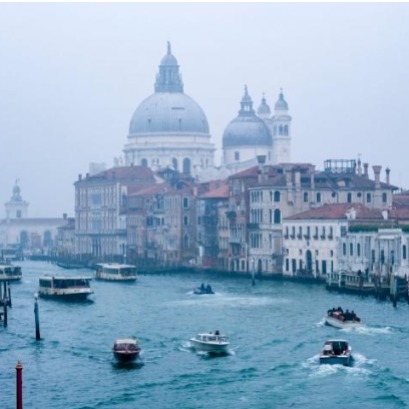
An inverted forest of millions of trees has held Venice for more than 1600 years
It is an millenary engineering work. For more than 1,600 years, Venice remains firm thanks to a unique foundation system in the world. These are millions of wooden posts stuck with the tip down in the muddy background of the lagoon. This base, which looks like an inverted forest, is composed of aler, oak, aliso, pine, fir and elmo. Thanks to this millenary engineering work, the city was officially founded on March 25, 421. Taking advantage of the laws of physics, monumental buildings have been built on land that seemed unstable. Only Rialtos bridge rests on 14,000 piles, while the Basilica of San Marcos sits over 10,000 oaks. No one knows how many wooden posts there are in total under the entire city, but the Venetian foundations have more than 16 centuries fulfilling their function, unlike modern materials such as concrete or steel, which have a projected life of 50 years on average as according to Alexander Puzrin, professor of geomechanics and geosystem engineering at the Federal Polytechnic University of Zúric.
A masterpiece of traditional engineering Battipali, workers specialized in the placement of posts, played a fundamental role. They stuck the posts by hand, singing to maintain rhythm and morals. His work was so recognized that he left popular Venetian expressions still in force, as I na Testa da Booter Pài, which means he has a head of knocking down piles and is used to describe someone clumsy. The piles were placed from the edge to the center, with a density of nine per square meter in a spiral. On them were installed beams or wooden planks, and finally, the stone of the building. To guarantee a constant wood supply, the Republic of Venice implemented pioneering forest conservation practices. In 1111, the first Italian document was recorded on sustainable forest management, in the FEMEME Valley, which allowed to preserve its forests until today. Stability under a threat controlled Venice solidity is not only due to wood. It is the combination of wood, water and mud that maintains stability. Although bacteria affect wood even in the absence of oxygen, the process is very slow. In addition, the water occupies the empty spaces and the mud maintains the pressure, which prevents structural collapse. Recent studies, such as that made by the universities of Padua and Venice, show that the wood has damage, but the system continues to work. The bell tower of the Church of Frari, for example, has sunk 1 millimeter per year since 1440. Despite this, the structure remains stable, thanks to the original engineering and the environment that protects it. Although during the nineteenth and twentie earthquakes However, as experts warn, it is not viable to build entire wooden cities. Since more than 1,600 years ago, Venice remains firm thanks to a unique foundation system in the world. These are millions of wooden posts stuck with the tip down in the muddy background of the lagoon. This base, which seems like an inverted forest, is composed of Alerce, Roble, Aliso, Pino, Apute and Olmo. Thank this millenary engineering work, the city was officially founded on March 25 of the year 421. Taking advantage of the laws of physics, monumental buildings have been built in a land that seemed unstable. Only Rialtos bridge rests on 14,000 piles, while the Basilica of San Marcos sits over 10,000 oaks. No one knows how many wooden posts there are in total under the entire city, but Venetian foundations have more than 16 centuries fulfill Geomechanics and Geosystems Engineering at the Federal Polytechnic University of Zúric. A masterpiece of traditional engineering Battipali, workers specialized in the placement of posts, played a fundamental role. They stuck the posts by hand, singing to maintain rhythm and morals. His work was so recognized that he left popular Venetian expressions still in force, such as you à na Testa da Bater Pài, which means has a head of knocking down piles and is used to describe someone clumsy. The piles were placed from the edge to the center, with a density of nine per meter square in a spiral. On them were installed beams or wooden planks, and finally, the stone of the building. To guarantee a constant wood supply, the Republic of Venice implemented pioneering forest conservation practices. In 1111, the first Italian document was recorded on sustainable forest management, in the FEMEME Valley, which allowed to preserve its forests until today. Stability under a threat controlled Venice solidity is not only due to wood. It is the combination of wood, water and mud that maintains stability. Although bacteria affect wood even in the absence of oxygen, the process is very slow. In addition, the water occupies the empty spaces and the mud maintains the pressure, which prevents structural collapse. Recent studies, such as that made by the universities of Padua and Venice, show that the wood has damage, but the system continues to work. The bell tower of the Church of Frari, for example, has sunk 1 millimeter per year since 1440. Despite this, the structure remains stable, thanks to the original engineering and the environment that protects it. Although during the nineteenth and twentie earthquakes However, as experts warn, it is not viable to build entire wooden cities. Since more than 1,600 years ago, Venice remains firm thanks to a unique foundation system in the world. These are millions of wooden posts stuck with the tip down in the muddy background of the lagoon. This base, which seems like an inverted forest, is composed of Alerce, Roble, Aliso, Pino, Apute and Olmo. Thank this millenary engineering work, the city was officially founded on March 25 of the year 421. Taking advantage of the laws of physics, monumental buildings have been built in a land that seemed unstable. Only Rialtos bridge rests on 14,000 piles, while the Basilica of San Marcos sits over 10,000 oaks. No one knows how many wooden posts there are in total under the entire city, but Venetian foundations have more than 16 centuries fulfill Geomechanics and Geosystems Engineering at the Federal Polytechnic University of Zúric.
IT MAY INTEREST YOU
 The DNA of forests: they discover what makes a tree resist drought
An international team, with the participation of INTA and Conicet, discovered that genetics can be decisive for trees to better resist droughts
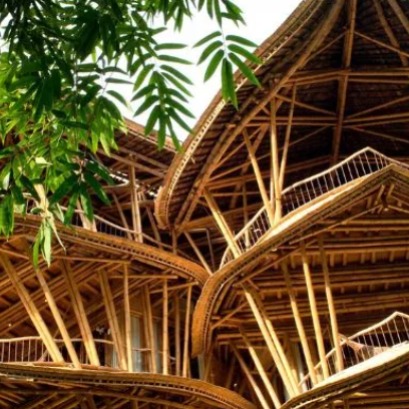 The South American country that changes construction thanks to an ancient, mega-resistant material: more than steel
This material that grows in South America creates the most resistant constructions and radically changes the world of architecture One particular building material has been used for millennia by various cultures in South America. This is due to its structural resistance that allows the creation of homes, bridges and shelters. Its archaeological presence shows that it was one of the most valued construction resources in seismic and humid areas.
 Nation reinforces prevention and training against forest fires
The director of the Federal Emergency Agency (AFE), Santiago Hardie, referred to the support that the Nation provides in fighting fires. He argued that the majority of igneous sources respond to human interventions and that, therefore, social awareness is a central tool to reduce environmental, material and human damage.