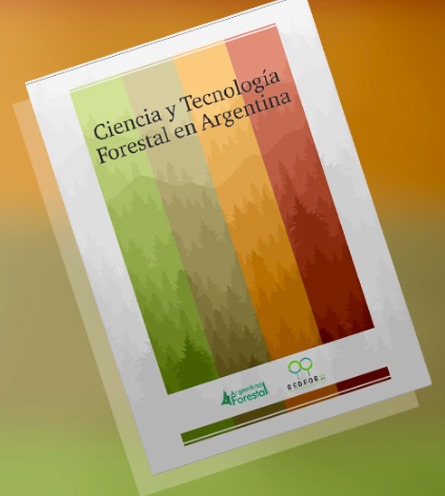
Launch of the book “Forest science and technology in Argentina”
This is a compilation of research notes and opinions from Argentine scientists, with international collaborations, on forestry sciences. The Argentine Network of Forest Science and Technology (REDFOR), which is part of the Institutional Networks Oriented to Problem Solving (RIOSP) of the National Council of Scientific and Technical Research (CONICET), which depends on the Scientific and Technological Development Management of the Council, presents the book “Forest science and technology in Argentina”. It is the second book of the Network, in conjunction with the magazine Argentina Forestal, which compiles two years of publications on the research activities of different groups in the country and the world and different approaches to thinking about forest science and technology.
As Cristina Area, CONICET researcher at the Misiones Materials Institute (National University of Misiones – CONICET), one of the authors and editors of the book, explains, part of the objectives of REDFOR.ar is to generate the necessary mechanisms to address and disseminate in society the social, cultural role and environmental and economic importance of forests. For this reason, the Permanent Communication Commission was created, through which the strategic alliance with Argentina Forestal emerged. “This alliance has made it possible to disseminate the work of researchers and extensionists on issues related to the Internet in this important medium,” said the scientist. “However, the possibility of compiling the articles in a book provides a different permanence, allowing us to reach a broader and more extended audience over time,” added Area.
For her part, Ana María Lupi, forestry engineer at the National Institute of Agricultural Technology (INTA) and one of the editors of the book, said: “It is a new achievement of REDFOR.ar in alliance with Argentina Forestal.” And she continues: “This demonstrates that networking, bringing together groups of different themes and geographical spaces, results in greater learning and synergy in the dissemination of knowledge.” Lupi valued the contribution of research groups from abroad, especially highlighting the teams from Colombia.
The issue covers topics such as innovation, forestry, environment, technology, industry and various opinion pieces on forestry sciences. The material, which contains 21 opinion pieces and 16 technical articles, was produced by members of the public sector and the country's academic and scientific system. Thus, the book has 275 pages that can be addressed by different audiences.
REDFOR.ar is a joint initiative of institutions linked to forestry sciences. It is made up of teachers, researchers and different institutions related to education, science and forestry technology. The objective of the Network is to coordinate the actions of generation and transfer of scientific-technical knowledge related to the sector.

IT MAY INTEREST YOU
 Combilift Unveils the 2025 Christmas video “Twelve Days of Christmas” – with a Twist!
Monaghan, Ireland – November 2025
 The second largest wetland in South America is located in Argentina: what is it?
Argentina has national parks that place it in a unique position within South America, competing with 300 others. Which is the largest? South America is home to more than 300 national parks, but many go unnoticed. There are extensive wetlands that have been the subject of major ecological restoration projects, to coastal mountains with deep indigenous heritage. Today we tell you the case of one located in Argentina.
 Free seminar on the implementation of the European EUDR regulation on deforestation-free wood products
The Argentine Forestry Association (AFoA) organizes the seminar «EUDR in Forest Products: Current status of implementation. Regulatory requirements and private experiences", which will take place on Wednesday, November 26, from 11:00 a.m. to 12:00 p.m., via Zoom, with live streaming on YouTube. The European Regulation on Deforestation-Free Products (EUDR) will enter into force on December 31, 2025 and will impose new requirements for forest products entering the European Union market.