
The planet's green belt is shifting and worries experts: terrestrial vegetation accelerates its migration towards the northeast
The planet’s green belt is on the move, with terrestrial vegetation having steadily accelerated its migration toward the northeast for decades. This is confirmed by a study published in the journal PNAS, led by the University of Leipzig and the German Centre for Integrative Biodiversity Research (iDiv), with the collaboration of the University of Valencia and other international institutions.
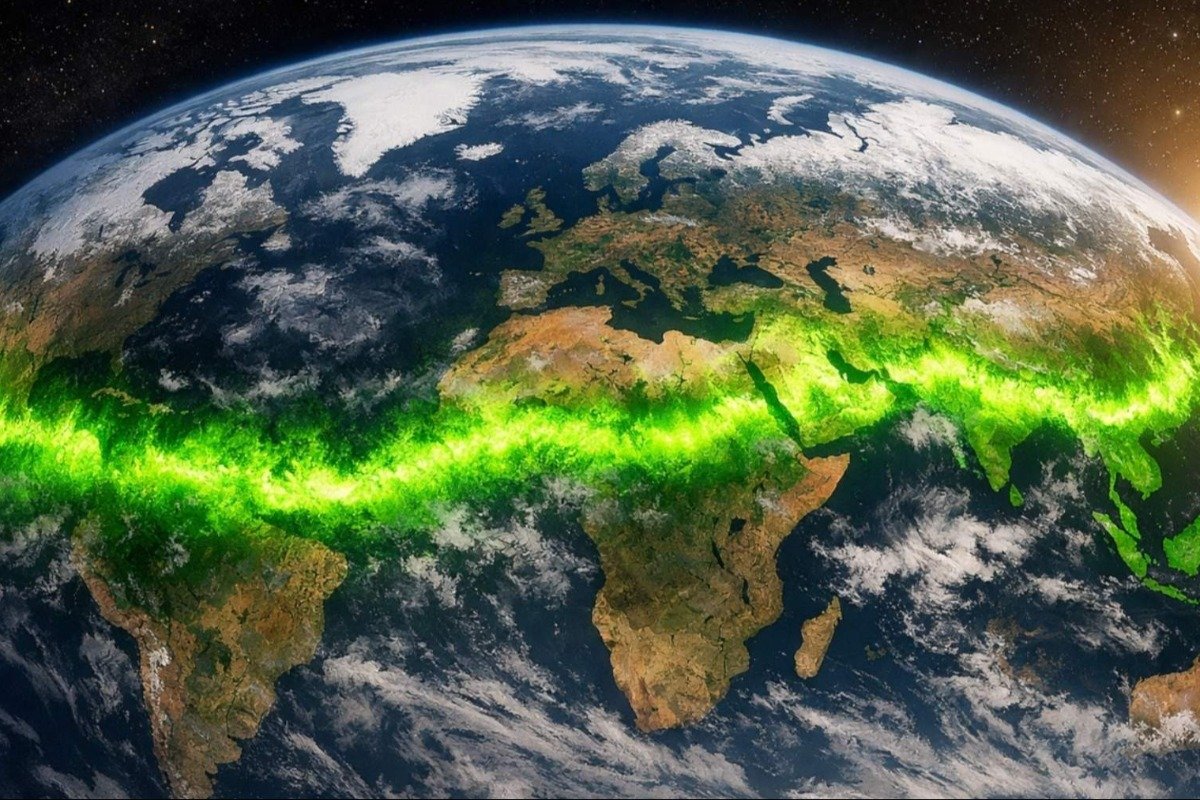
The research introduces a new method capable of tracking the pulse of the biosphere on a global scale.
The conceptual starting point is as intuitive as it is powerful: the researchers calculated the "center of mass" of Earth’s greenery—that is, the point at which the planet would be balanced if every patch of vegetation were assigned a weight proportional to its leaf density. By tracking the movement of this point over time, science now has a compass to measure how, and at what speed, the planet’s green belt is changing.
The heartbeat of the biosphere
Using satellite observations and climate model data spanning several decades, the team tracked the seasonal shifting of this "green center." In sync with the seasons, terrestrial vegetation moves like a wave—from the Northern Hemisphere to the Southern Hemisphere and back again each year—describing a constant, measurable oscillation.
The analysis determined that the green center reaches its northernmost position in mid-July, in the North Atlantic near Iceland, and its southernmost point off the coast of Liberia in March. "Essentially, we have compressed the complexity of the biosphere into a single, moving heartbeat," stated Professor Gustau Camps-Valls of the University of Valencia, who contributed to the research design and the development of the underlying theory.
An unexpected eastward shift
By cross-referencing decades of data, the scientists detected a dual shift that had not been anticipated in their initial hypotheses. In addition to the steady northward progression, they confirmed a clear eastward movement of the green belt—likely linked to particularly pronounced "greening" hotspots in India, China, Europe, and Russia.
"It came as a great surprise to us," acknowledged Professor Miguel Mahecha, the study’s lead author. Longer growing seasons and milder winters in the Northern Hemisphere—which allow land vegetation to remain slightly greener for longer—may be driving this dual shift. The team emphasizes, however, that this remains a hypothesis requiring further investigation.
CO? as a Driver
The study provides new data on "global greening"—a lesser-known aspect of global change that describes an overall increase in vegetation density worldwide. Rising atmospheric CO? concentrations act as a fertilizer, boosting photosynthesis and pushing the "green belt" into regions that were previously less lush, while higher temperatures extend growing seasons in many areas.
Contrary to expectations, the analysis did not reveal a corresponding southward shift during the Southern Hemisphere summer, highlighting an asymmetry between the hemispheres in how land vegetation responds to climate change. This finding reinforces the idea that the Northern Hemisphere is currently the primary locus for global greening dynamics.
Beyond Forests
The methodology goes beyond simply tracking greenery. The same theoretical framework can be adapted to follow a "blue wave" in the oceans or a "red wave" of thermal anomalies, pointing toward a multidimensional tool for monitoring the pulse of the Earth system as a whole. Tracking the green belt thus connects various vectors of global change: interactions between the climate and the biosphere, land-use changes, fire dynamics, droughts, and animal migration.
For the first time, science possesses a compass capable of precisely measuring how the planet’s living surface is reorganizing itself in a world that continues to warm.