
U. de Chile study warns of critical risk for araucaria forests by 2060
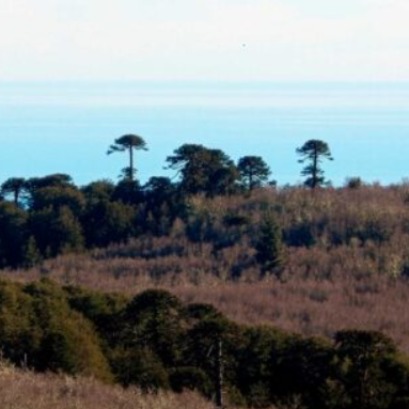
Araucaria forests in Chile would face a critical threat to their survival by 2060. This is one of the main results of the research titled “Climate-driven collapse risk in Chilean Araucaria forests,” which analyzed the four araucaria ecosystems present in our country: three of them located in the mountain range, between the regions of La Araucanía and Los Ríos, and one located in the coastal area of ??the Nahuelbuta Mountain Range.
To this end, the research team was led by Professor Alberto Alaniz, an academic from the Department of Animal Biological Sciences of the Faculty of Veterinary and Livestock Sciences (Favet) of the University of Chile, and integrated by Alexis Barrios-Saravia, Claudia Hidalgo-Corrotea and Pablo Vergara, members of the Biodiversity and Environment Laboratory (BIOMA) of the University of Santiago de Chile. The study evaluated five main dimensions:Historical loss of area, since approximately 1750.• Recent loss of area, especially between 2004 and 2024.• Future loss of suitable habitat, projected towards 2060.• Changes in climate variables, such as temperature, precipitation and drought.• Changes in forest functioning, using satellite indicators related to water, transpiration and canopy cover. • This research represents the most detailed Red List of Ecosystems evaluation applied in Chile and one of the most complete worldwide. All ecosystems showed a severe historical reduction in their surfaces (74%) and a significant recent decrease, with Andean ecosystems being particularly affected by deforestation, with more than 46% loss. Climate change projections indicate that there will be a widespread loss of environmentally viable areas, where the coastal araucaria forests of Nahuelbuta could completely lose environmentally viable conditions by the year 2060,” explains Professor Alberto Alaniz. • The evaluation determined that the four araucaria ecosystems could reach the Critically Endangered (CR) category by 2060, under the official protocol of the Red List of Ecosystems of the International Union for the Nature Conservation (IUCN). This implies that they would reach the highest risk levels established in accordance with the organizations scientific standards.• Among the factors associated with this result, climate change appears as the main projected risk factor.• The study evaluated a total of 9 sub-criteria of a maximum of 12 sub-criteria proposed by the IUCN, including multiple variables for the same criterion. Climate factors were those that determined the highest levels of threat for all the ecosystems evaluated, considering changes in the same criterion. precipitation, temperature and drought conditions. On the other hand, the distribution reduction criteria did not reach the highest threat levels. When the criteria related to functional processes of the ecosystems are analyzed, extensive degradation is evident, which is mainly linked to climate change (water stress), details the Favet academic.• Another result that draws attention in the scientific article is the loss of surface area recorded in the four ecosystems. The team of authors determined that they have lost more than 74% of their ecosystems. historical extension. In some cases, the reduction exceeds 90% compared to the estimated presence for the pre-industrial period. This shows that the threat is not exclusively future: the araucaria ecosystems have already suffered a considerable and sustained reduction over time.• Urgent measures to protect the araucaria• Based on the five dimensions of impact analyzed, the research proposes taking urgent measures to protect these ecosystems.• First of all, a presidential decree should be generated where these ecosystems are declared a national priority. Currently, the Araucaria araucana species is considered a Natural Monument, and its cutting and commercialization is prohibited. However, the ecosystem where it is located is not a directly declared conservation object, with a risk of habitat degradation due to poor management practices, says Professor Alaniz. Likewise, the study proposes specific measures such as: o Inclusion of all remaining araucaria patches and/or hedges within the regulatory plans as conservation zones, without allowing their change. of land use and cover.o Declaration of national restoration priority within the National Landscape Scale Restoration Plan and within the framework of Law No. 21,600, which creates the Biodiversity and Protected Areas Service. This declaration should be formalized by a decree issued by the Ministry of the Environment and ratified by the Comptrollers Office, with the respective approval of the President of the Republic.o Expansion of conservation areas through mechanisms such as the real right of conservation, the acquisition of land and the implementation of private protected areas, especially in the area of the Nahuelbuta National Park, where the coastal araucarias are found, and in the buffer zones located between the protected areas of the mountain zone of the La Araucanía Region. o Implementation of a plan for adaptation to climate change through the conservation of germplasm (seeds), considering the selection of seeds, nursery, selection of seedlings and reforestation on the ground. The necessary funds should be approved for the execution of scientific research activities focused on the ecological restoration of this ecosystem, from laboratory studies to the financing of direct intervention actions in the field, such as preparing substrates, planting trees and implementing measures for water harvesting and increasing water retention.o Regularization of the massive trade in pine nuts, identifying quotas and maximum extraction quantities, promoting responsible extraction for local markets and reducing large-scale exploitation, such as that destined for large chains of production. supermarkets. Araucaria forests represent an immeasurable biological and cultural heritage, being one of the oldest groups of species in the southern cone of South America, as well as a plant of high importance for the Mapuche people. This study presents a direct alarm to begin executing actions to ensure the persistence of this ecosystem for future generations, with the objective of preventing them from disappearing, concludes Professor Alberto Alaniz.