
The Sorrento workshop that turned wood into art
Creators in 1920, the Biagio Barile workshop imposed a technique that is today famous throughout the world and that the family of founders continues to defend, piece by piece, as a legacy
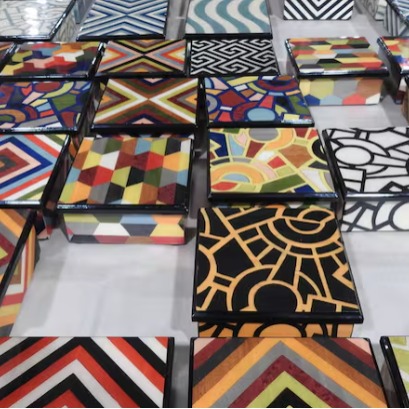
Between the saw and family memory, this Italian craftsman understands wood as a territory that is inherited and reinvented at the same time. From his workshop, which is also his world, his craft reveals what it means to sustain, generation after generation, the art of intarsio, an artisanal inlay technique that inlays small pieces of different materials—such as wood, bone, mother-of-pearl...—on a surface, to create special designs. At the age of six, in his fathers and grandfathers workshop, in the heart of Sorrento, Enzo Barile held a saw that was barely a millimeter thick for the first time. He began to attend that workshop from a very young age because, as he says, a childs mind is free and he learns more easily. The Biagio Barile workshop was founded in 1920 by his great-grandfather, also called Biagio, who imposed the practice of tarsia in the city, a local marquetry technique famous throughout the world. The craft then passed to Vincenzo, and today Enzo continues it with his father, Biagio: together they represent the fourth generation of intarsiators in the family. Sorrento tarsia arrived on the peninsula at the end of the 16th century, when the Benedictine monks of the monastery of SantAgrippino began to decorate liturgical objects with small wooden blocks. It reached its splendor two and a half centuries later, during the Grand Tour, when travelers like Goethe, Stendhal and Wagner stopped in the city and took chests and trays as souvenirs. It was then that the cabinetmaker Antonino Damora refined the contrast between dark walnut and light orange, which still distinguishes the local tarsia from other Italian traditions, and when the coastal landscape, tarantella and peasant scenes became the most sought after motifs by European collectors. In 1886 the city founded its own school of art applied to intarsio, and today the Museo Bottega della Tarsia Lignea preserves pieces by those masters, as well as contemporary production from the Barile family workshop. The label of heir accompanied him since he was a child, but over the years his role expanded far beyond the received tradition: today he is an artisan, designer and one of the most lucid voices in thinking about intarsio as an art in permanent tension between the past and the present. Our company comes today, with me, to glimpse a perspective that we did not have in the past, he says. In his way of speaking, the continuity of the family trade appears as a daily choice, the result of a daily coexistence with wood. The technique, far from being reduced to the repetition of an inherited gesture, was the object of a deliberate transformation. About twenty years ago, my father and I created a style of intarsio that was different from the traditional one, the modern style, always without abandoning ancient techniques, he explains. For Enzo, this dialogue between new and old requires strict fidelity to manual work. Trimming techniques should be traditional, with a one millimeter saw, and I am completely opposed to the use of lasers. The products have to be handmade and imperfect, the client must understand and see that they are artisanal objects, not mass-produced objects. Intarsio is born from a simple gesture, which becomes complex with repetition: cutting thin sheets of wood, called impiallacciature, and assembling them like pieces of a puzzle until composing an image. It all starts with a drawing, he relates, a coastal landscape, a peasant scene or a geometric composition, which is first traced on paper and then transferred to the sheets before cutting. Our workshop works with wood from local vegetation: walnut, orange, olive and lemon, combined with darker species, such as ebony and rosewood, to achieve contrast. Each sheet is cut out following that drawing and fitted piece by piece onto a solid wood support. To achieve shadows and volumes, we still resort to a centuries-old technique: we briefly dip the edge of each sheet in hot sand, until the heat toasts the fiber and produces a natural gradient that imitates the chiaroscuro of a painting. In the end, the surface is sanded and varnished until the grain of each wood is visible, as if they were brush strokes. The result of this slow and manual process is applied today to very different objects. Chests and jewelry boxes, trays, mirrors, paintings and tables coexist in the workshop with more ambitious commissions, decorative panels, custom furniture and design pieces designed for hotels and international boutiques. Traditional scenes, coastal landscapes, floral motifs, the tarantella danced by peasant couples, continue to appear alongside geometric compositions of a more contemporary style, the modern line that particularizes the workshop within tradition. In all cases, the finished piece preserves the irregular texture of hand-crafted wood, the mark that distinguishes a Sorrentine tarsia object from a simple printed imitation. That balance, which requires maintaining two languages ??of the same art, became over time a conscious discipline. Balancing modernity with the ancient history of intarsio is very difficult, they are two styles of the same art completely different from each other - he acknowledges -. I try to achieve this by maintaining color combinations that do not stray completely from traditional schemes. A new collection faces, in its own way, that same challenge. Every time we create new collections, something that the company changes periodically, it is always a new challenge. I try to imagine the taste of the end client and, above all, the place that our objects will occupy in todays homes. A craft about to be lostWood, for Enzo, requires a respect that begins long before the piece reaches the clients hands. The difficulties when working with this material are many, even sensitive to climatic variations and the country of origin of the wood - he expresses -. You should never underestimate the raw materials being used to avoid future problems in the finished product. This demand for the material coexists with a demand of the time: to sustain an artisanal trade in a market that changes tastes every season. The perception of intarsio has completely changed in the last two decades, according to the demands and tastes of the clientele - he reflects -. That is why I believe that we must always propose something that is integrated into current environments and that also attracts a young audience. Behind this reflection lies a greater concern: that of a profession that shrinks with each passing decade. Like all crafts, intarsia is at risk of disappearing here in Sorrento, he admits. In the last twenty years there were only a dozen workshops left, when in the nineties there were more than three hundred. Unfortunately there was no generational change. Faced with this panorama, Enzo places his hope in the families that still choose to pass on the trade. I hope that many parents guide their children towards crafts, as my wife and I are doing with ours. Biagio Bariles pieces have, over the years, crossed the walls of the family workshop. Exclusive designs adorned Gucci and Christian Dior collections. The familys boxes, mirrors and paintings are sold today at Neiman Marcus, Bergdorf Goodman, the Smithsonian, Rinascente and Liberty in London, in addition to the store itself in Sorrento. However, for Enzo, working with an international brand hardly changes the logic of the workshop: An order from a big brand does not differ too much from other orders, because many times we are the ones who propose the designs and color combinations, always leaving the last word on the samples to them. This naturalness in the face of international recognition is rooted in a very specific pedagogy, the one that Enzo received from his father and that today he tries to transfer to his own son. “The lessons I received and continue to receive from my father are many, but the most important is experience,” he says. Having a father behind you, who not only teaches, but also keeps you grounded and makes you constantly bathe in humility is very important to me, and makes it easier for me to get closer to my clientele. That same humility is, for him, the inheritance that is best transmitted. I try to teach my son, at work as in life, respect for others and education. They are the two main ingredients, without which you will not get anywhere, he concludes, with the calm certainty of someone who knows that intarsia, after a hundred years, is still a family thing.