
In 1927 they discovered a 65 million year old forest in Chubut: 43 years later it became a protected area
The discovery revealed thousands of trees transformed into stone in a Patagonian territory that once had a tropical climate In the middle of the Chubut steppe, where wind, aridity and rock formations currently predominate, there is a landscape that preserves an extraordinary secret: thousands of trunks, branches, leaves and seeds turned into stone.
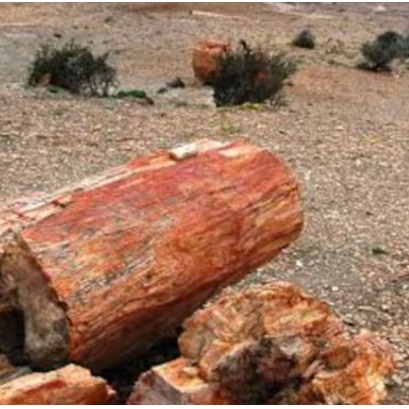
The place began to be known in 1927, when a huge paleontological site was discovered near the city of Sarmiento. The remains preserved the shape, the grain and even the texture of the wood, although they had lost all their organic matter millions of years ago. Currently, the site is known as Sarmiento Petrified Forest or José Ormachea Petrified Forest. It is located about 28 kilometers from Sarmiento and houses plant fossils with an estimated age of 65 million years. When Patagonia was a tropical forest, the Chubut landscape was completely different when those trees were still standing. Instead of the current steppe, the region was covered by humid forests, rivers and swampy areas. In that environment, conifers, palm trees and primitive ferns grew. Some trees reached extraordinary heights before being washed away by water courses to a low area, where they were covered by ash and sediment. The mineral-laden water slowly penetrated the wood and replaced its organic components with silica. This process, known as petrification, allowed the trunks to maintain their original appearance, but to transform into rock. Millions of years later, erosion caused by wind and water once again left the fossils exposed. The discovery of a landscape frozen in time When the forest was identified, there were still not enough measures to protect it. For decades, numerous remains were exposed to extraction, deterioration and the extreme conditions of Patagonia. The discovery attracted researchers interested in reconstructing the regions geological past. The fossils allowed us to understand how the climate, soil and ecosystems of southern Argentina changed. The trunks appear lying on the ground and fragmented into large sections. Many preserve such precise details that they appear to have been cut recently, although they belong to trees that existed long before the appearance of humans. It became a protected area 43 years later In 1970, exactly 43 years after its discovery, the place began to be organized as a natural attraction and conservation area. The decision sought to protect one of the largest concentrations of petrified wood in Patagonia. It subsequently received the category of Natural Monument, intended to preserve exceptional sites due to their rarity, scientific importance and landscape value. The protected area comprises around 1832 hectares. In addition to the fossils, it protects current species such as guanacos, gray foxes, Patagonian piches, wild cats and pumas. The trail that crosses a forest turned into stone Visitors can follow an interpretive trail of approximately 2.4 kilometers. Along the way, fossilized trunks, formations of different colors and natural viewpoints appear towards the so-called Lunar Valley. The circuit also has an interpretation center where paleontological remains and archaeological materials found in the region are exhibited. The Sarmiento Petrified Forest shows that no landscape is permanent. The territory that currently appears desert was covered by giant trees, waterways and tropical vegetation. Almost a century after their discovery, those trunks remain in the same place. They are no longer part of a living forest, but they preserve in stone one of the oldest and most surprising chapters of Argentine natural history.