
Industrialization is beginning to change the way buildings are built, and the ICM promotes works with wood
For decades, the image of a work remained practically intact: materials that arrive on site, workers who carry out each stage on site, unforeseen events that alter deadlines and processes that depend, to a large extent, on the conditions of the site. However, a transformation is modifying this logic in different markets around the world: more and more building components can be designed, manufactured and prepared before reaching the construction site.
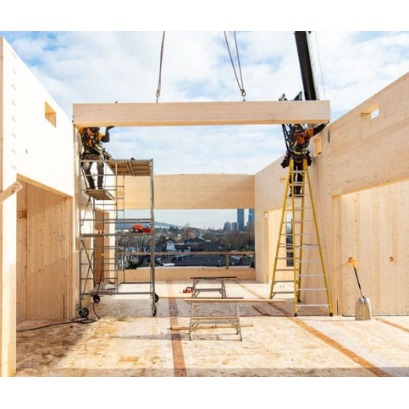
This change is known as the industrialization of construction and proposes applying planning, manufacturing and quality control processes to the sector that are already part of other industries. It is not simply about building faster, but about organizing the entire construction process in a different way, from the initial project to the final assembly, they point out in a press report from the Institute of Wood Construction (ICM). In this scenario, wood offers particularly interesting possibilities. Light framing systems, structural panels and engineered wood products allow progress towards solutions in which An important part of the components is produced with previously defined dimensions and specifications. The Institute of Wood Construction (ICM), promoted by the Argentine Federation of the Wood and Related Industries (FAIMA), seeks to highlight the importance of bringing these technologies and their possibilities closer to architects, engineers, developers, construction companies and professionals linked to the design and execution of buildings. The ICM promotes the knowledge, development and application of construction systems with wood, strengthening the link between the industry, professionals and the construction sector.From traditional construction to planned manufacturingIn conventional construction, numerous tasks are solved directly on the ground. Industrialization seeks to anticipate part of these decisions through more detailed projects, coordination between specialties and manufacturing of components under controlled conditions. In the case of wood, this can translate into framework structures, enclosure panels, load-bearing elements or modules that arrive at the site prepared for installation. The difference is not only operational. When pieces are produced from a coordinated project, it is possible to improve the predictability of tasks, reduce adjustments during assembly and organize the use of materials with greater precision. The construction site stops being the place where everything begins to be resolved and becomes, in part, the space where decisions made previously are assembled. This does not mean that jobs on the ground disappear nor that all projects can be industrialized in the same way. The choice of system depends on the scale, design, structural requirements, site conditions and the technical capacity of those involved, FAIMA points out. Wood is no longer a single construction system. When talking about construction with wood, there are several technologies to mention: The Wood Frame, for example, uses a framework of wooden structural pieces to form walls, mezzanines and roofs. Its design allows the incorporation of different layers and insulation and finishing materials according to the needs of each project. SIP panels usually combine two structural faces with an insulating core and can be used in certain enclosure and construction solutions, always in accordance with the design and the corresponding technical specifications. On another scale, engineered wood products appear, such as cross-laminated wood (CLT) and glued laminated wood (GLT or glulam), which allow the development of panels, beams and columns intended for different structural applications. Each system presents particular characteristics, requirements and possibilities. Therefore, one of the challenges is to overcome the idea that building with wood is exclusively equivalent to building a small house or a cabin. Today, the available technologies also allow us to think about more complex buildings, extensions, equipment, commercial spaces and infrastructure, as long as there is an adequate structural project and the applicable standards are met, indicated in the press report from FAIMA. Less improvisation, more integration between professionals. Industrialization requires more than incorporating machines or manufacturing panels. It requires a closer relationship between architecture, engineering, suppliers, manufacturers and assembly teams. Decisions on dimensions, joints, installations and construction sequence must be coordinated from early stages. Digital modeling and planning tools, together with cutting and computer-aided manufacturing technologies, can contribute to this integration. In this context, technical knowledge becomes as important as the chosen material. An industrialized solution needs trained professionals, adequate components, quality controls and an execution that respects the project. Construction with wood does not eliminate the requirements of structural safety, fire protection, humidity control, acoustic behavior or energy efficiency. On the contrary, it forces them to be resolved through design criteria, specifications and appropriate verifications. The challenge of changing the culture of building with wood In Argentina, the expansion of construction systems with wood faces challenges that exceed the availability of the material. The training of professionals, the dissemination of technical knowledge, the articulation between suppliers and designers, familiarity with the systems and the incorporation of industrialized solutions are necessary factors to expand their applications. It is also essential to communicate that industrializing does not mean producing identical buildings. Planned manufacturing can coexist with different architectural proposals, scales and design needs. The ICM promotes a view that integrates technology, training, quality and new opportunities for construction with wood, with the aim of contributing to the development of a more sector prepared to respond to current demands. Because transformation is not only about replacing one material with another. It consists of rethinking how it is designed, how it is manufactured and how it is built, summarized by FAIMA.