
Wood factories move from automating machines to making better decisions
A recent academic perspective argues that the next advantage in wood manufacturing will not come from adding isolated sensors, but from linking resource, process, product and system information into traceable decisions.
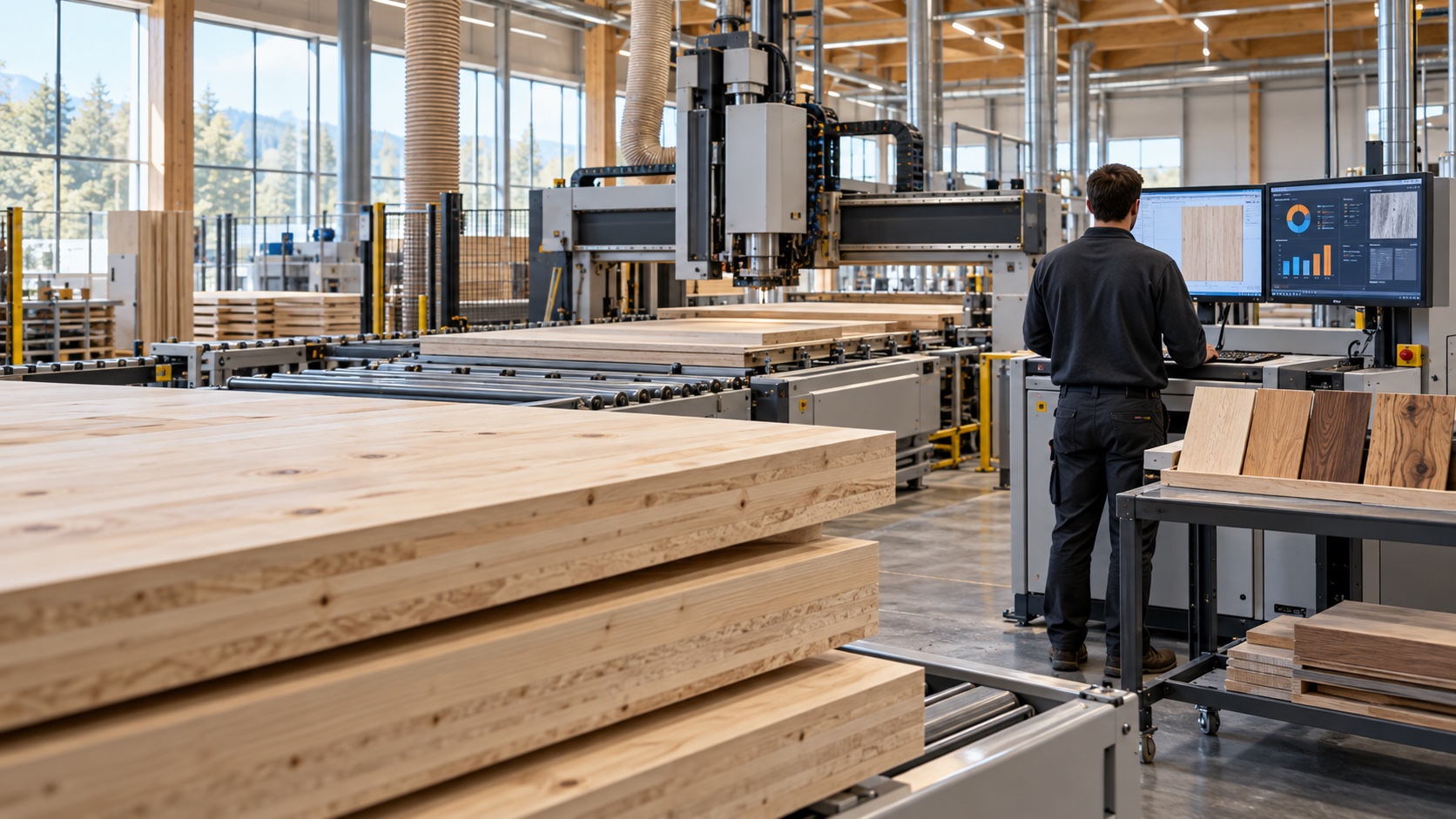
The next transformation in a wood plant may not look like a larger machine. It may look like a better decision made earlier. In a shop or factory, boards with knots, changing moisture or internal stress are not exceptions; they are the normal condition of a biological material. Competitive advantage emerges when that variability stops being discovered late — in a rejected component, an installation delay or a customer claim — and begins to guide cutting, grading, design and scheduling before it creates cost.
A perspective published on October 14 in the Journal of Manufacturing and Materials Processing frames exactly that shift. The paper on advanced wood manufacturing proposes organizing digitalization around decision intelligence. Rather than treating production, quality, resource and sales data as separate islands, the approach links them so that scattered signals can become specific operational choices. The idea matters because the sector is dealing simultaneously with more varied orders, tighter lead times, uneven resource quality and technology adoption that is progressing at very different speeds.
The first layer is resource intelligence. It includes information on species, origin, dimensions, moisture, visible defects, mechanical properties and expected recovery. In a conventional operation, some of that knowledge lives in the grader’s eye and in experience-based rules. Digitizing it does not mean replacing that craft; it means carrying it forward. A scanner, camera or meter can capture batch-level data, while a well-designed system connects it to a cutting order, gluing recipe or the intended use of each piece. A board then reaches the line not as generic volume, but with a history that helps determine where it can create the most value.
The second layer is manufacturing intelligence. This is where machine settings, energy use, cycle times, tooling, downtime, rework and quality checks belong. Making those records available does not guarantee an improvement. Value arrives when they are related to the material’s initial condition and to the finished result. If one component family shows machining variation, for instance, the question is no longer only whether the CNC followed its program. It can also ask whether a moisture band, tool geometry, adhesive selection or pressing sequence explains the outcome. That connection allows evidence-based process adjustment rather than adding more inspection at the end of the line.
The third layer is product intelligence. Industrial wood is no longer limited to a repeated stock item; it serves customized furniture, high-performance joinery, structural components and hybrid solutions. Each calls for different tolerances, finishes, strength, logistics and documentation. Linking product and process enables design for manufacturing: joints, thicknesses, modules and finishes can be specified to use the plant’s actual capability and to reduce waste. It also lets feedback from installation, use and service reach engineering. A fit-up problem on site or a finish that ages poorly becomes input for the next decision, not merely a post-sale expense.
The fourth layer, system intelligence, looks beyond a machine or cell. It connects inventory, suppliers, energy, maintenance, orders, transport and people’s capabilities. At this level, an efficient schedule is not one that keeps a saw occupied for the most hours. It is one that protects delivery dates, preserves raw-material yield and avoids moving bottlenecks into finishing, packing or the construction site. Flexible manufacturing needs that view to resolve the tension between variety and efficiency. Small batches can be viable when setup, sequence and material decisions are made with adequate information and at the right time.
The industrial impact is significant for both large plants and smaller manufacturers. It does not require beginning with a full automation overhaul. The more realistic path is often to select one repetitive and costly decision — grading lumber for its destination, prioritizing orders, reducing rework or anticipating maintenance — identify the missing data, and build an improvement routine around it. Interoperability and reliable records matter more than collecting dashboards. An attractive screen that nobody uses does not create intelligence; trusted data that changes a setup does.
The future trend will combine automation with human judgment rather than set them against one another. Analytical models and artificial intelligence can detect patterns across thousands of pieces and suggest scenarios, but they need clear boundaries, representative data and operators who can interpret exceptions. Wood will continue to behave as an individual material, and the strongest factories will be those that turn that individuality into yield, design quality and traceability. The opportunity is not to imitate a metal or plastics line. It is to build an industry that can decide precisely about a living and diverse material.
Source: Vahid Nasir, “A Perspective on Advanced Wood Manufacturing: A Decision-Centric Framework for Future Research and Education”, Journal of Manufacturing and Materials Processing, October 14, 2026, DOI: 10.3390/jmmp10100430.