
What is forest resilience and how it will be studied in Patagonia
The initiative received a grant from the Williams Foundation. The work will be carried out by scientists from the Andean Patagonian Forest Research and Extension Center (CIEFAP). What will be the steps they will take to provide knowledge, as detailed in dialogue with Diario RIO NEGRO.
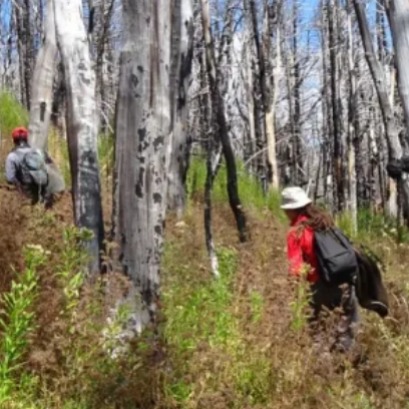
Patagonian forests face an enormous challenge from fire. These unique ecosystems are suffering severe damage from the increase in forest fires in the region. Forest resilience is the ability of a forest to respond to a disturbance and recover its balance over time. Specialists study this faculty to understand the natural healing process. Now, doctors Florencia Urretavizcaya and Melisa Rago are looking for key answers for the survival of these landscapes. With a subsidy awarded by the Williams Foundation, the researchers will analyze how the territory manages to react after a large-scale catastrophe. Both belong to CONICET and the Andean Patagonian Forest Research and Extension Center (CIEFAP), located in Esquel, Chubut.Fire against the forest________________________________________It is known that the increase in fire intensity puts local biodiversity at risk. These events alter the natural structure that protects soil and wildlife. Structural damage hinders natural regeneration and endangers future survival. Therefore, the fragility of the environment requires concrete measures for its conservation. The lack of adequate strategies may prevent the response from being effective in the face of the current magnitude of the fires. The main objective of the researchers is to study the recovery dynamics of the Andean-Patagonian forests affected by fires. We are going to generate knowledge that will serve to design management and conservation strategies, explained Urretavizcaya, forestry engineer and doctor in biology, who was interviewed by DIARIO RÍO NEGRO. The work links forest resilience with the impact of active ecological restoration. Forest resilience is the capacity of a forest to respond to a disturbance, such as a fire, and recover or reorganize its structure and functions over time, he explained. Lights on the ash________________________________________The researchers will evaluate the vegetation in affected sites during different years. They will analyze how the forests own resilience interacts with the new environmental conditions. They will focus on coihue forests affected with high severity in the last decade. The field work covers areas of the mountain range in Chubut and Río Negro. In this case, we are going to focus our study on coihue forests, whose scientific name is Nothofagus dombeyi, which have burned with high severity in the last ten years in the region of the Patagonian mountain range, located in the north of Chubut and Río Negro, explained Dr. Rago. The project will examine the human influence on the regeneration of the plant environment. Furthermore, in this project we are going to study how ecological restoration contributes to the recovery of forests, he commented. They will compare areas with restoration techniques against other areas without intervention. Particularly, they will focus on this topic on beech tree (Nothofagus pumilio) when characterizing post-fire restoration plots carried out by plantations, which are already 16 years old. We will study which plant species predominate at each moment and what role they play. For example, we want to know if they promote the recovery of nutrients in the soil, and also how biological activity is recovering, added Urretavizcaya. The project execution time totals one calendar year. This project is for one year, so now we are planning the sampling that we will carry out this spring and summer, they clarify. The scientists anticipate writing results during the fall and winter months. The team considers the need to sustain this long-term monitoring after the initial period. Given that the recovery of forests after fires is a long-term process (or that lasts decades), we hope to continue with these lines of research through future funding, Urretavizcaya pointed out. Coihue and lenga: differences and characteristics of two native trees________________________________________The coihue (Nothofagus dombeyi) and the lenga (Nothofagus pumilio) are native trees of Argentina and Chile. They belong to the same genus and share part of their distribution, but have different characteristics and growth environments, according to the Biodiversity Information System of the National Parks Administration. The coihue is an evergreen tree that can reach about 40 meters in height. It prefers moist soils and grows well near rivers and lakes. In Argentina it is found in the provinces of Neuquén, Río Negro and Chubut. Lenga is a deciduous tree: it loses its leaves during the fall. It can reach about 30 meters in height. In low areas it has a tree-like appearance, while in high areas or areas exposed to the wind it can adopt a low and stunted shape. There are also differences in the altitude where they grow. The coihue appears from sea level to about 1,000 meters, while the lenga can grow up to about 1,500 meters. In the north of its distribution, the lenga can form the upper limit of the tree vegetation. Coihue and lenga share a genus and territory, but they are distinguished by their leaves, their size and the environments where they grow. The coihue retains its leaves throughout the year and prefers humid soils; The beech tree loses its leaves and can grow in higher and more exposed areas.