
It is extraordinary, it is not done every day: they move a 500-year-old, 6,000 kilo olive tree to plant it in a private garden
How is a six-ton, half-millennium tree moved from a nursery to a private farm?
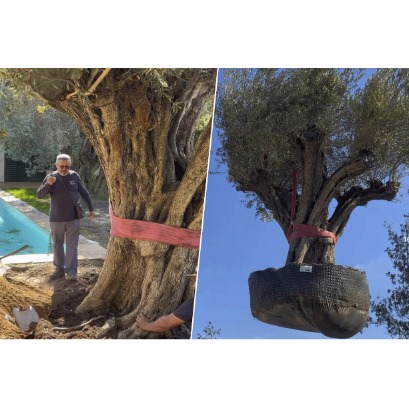
If we had a time machine and could go back to the beginning of the 16th century, we would find Charles I sitting on the throne, Garcilaso de la Vega composing sonnets, and explorers like Núñez de Balboa or Ferdinand Magellan showing their contemporaries that the world is a smaller place than they believed. If we traveled specifically to 1525 (decade up, decade down) we would also see a small olive tree sprout that now, half a millennium later and weighing 6,000 kilos, shines in a private garden in Spain. The fact would not have much importance if it were not for the fact that it has arrived there after a fascinating operation that required a huge crane and a lot of skill. It is not done every day. When you think about special road transport, the first thing that comes to mind are huge gondola trucks and modular vehicles loaded with wind turbine blades, boats fresh from the shipyard, cylinders, silos or large pieces of concrete. A few months ago Jardines con Vida, a Valencian firm, reminded us that sometimes the challenge is something different: it is not about transporting vehicles or machinery, but rather ancient living beings that weigh several tons. Like, for example, a centenary olive tree. Their movements are so complex that, recognizes the head of the nursery, José González, it is something extraordinary that is not done every day. Moving a 500-year-old tree? Exact. Its not something exceptional, but you dont see it every day either. Hence, last fall González decided to document how these types of operations are carried out. The story is very simple: his client had a large pine tree presiding over his garden that ended up being knocked down by a storm, so he decided to fill its space by purchasing a five-century-old, 6,000 kg olive tree. They selected it in the nursery itself and took it home after a month. It sounds easy, but it is not. As González explains, the maneuver required mobilizing several operators, a special gondola truck and a crane capable of lifting the tree several meters high to the place on the farm where the nursery technicians had dug a large hole. Once deposited there, they buried its roots and watered them. The order, González specifies, required an entire morning. For select pockets. The prospect of having a large olive tree and five centuries in your garden may sound attractive, but before considering it you must be clear about something: it does not come cheap. A specimen that is several decades old can cost hundreds of euros, a figure that skyrockets if we are talking about trees that have exceeded a century of life. In that case the fee can easily exceed 1,000 euros. Everything will depend on the type of tree, its dimensions and age. A quick search shows companies that sell 50-year-old olive trees for almost 400 euros and centenary specimens for 700, while others recognize that, depending on size and age, the bill can range between 1,500 and 20,000 euros. Sometimes the price of the tree must be added to the cost of transportation between the nursery and the private property, in addition to the work to plant it.